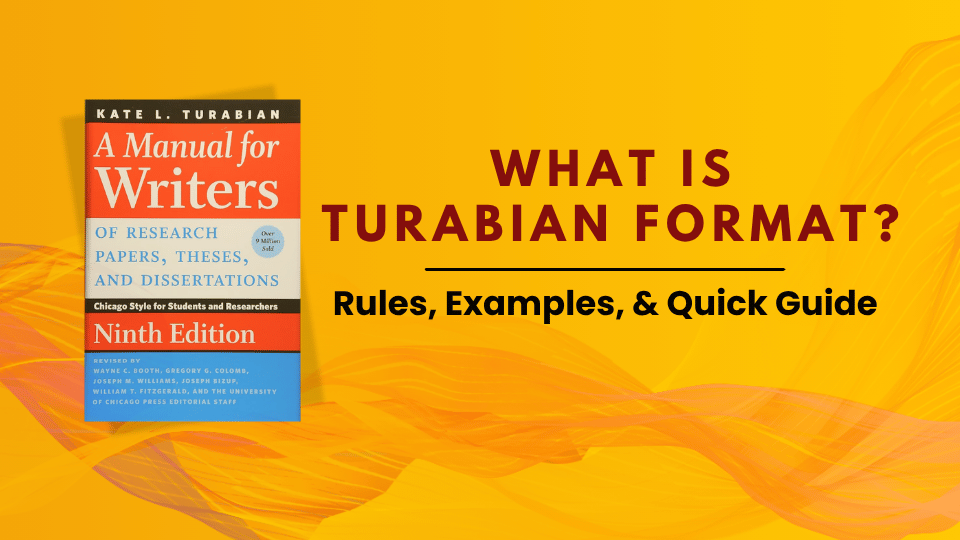


Turabian is a citation and formatting style used primarily in history, theology, religious studies, literature, and other humanities disciplines. Based on the Chicago Manual of Style but written specifically for students, it’s been guiding academic writers since the mid-twentieth century and is now in its 9th edition.
What is Turabian format?
Turabian format takes its name from Kate L. Turabian, who served as dissertation secretary at the University of Chicago and developed the style to help students navigate the rules of the Chicago Manual of Style. Her guide – officially titled A Manual for Writers of Research Papers, Theses, and Dissertations – remains one of the most widely used style guides in academic writing.
Turabian is closely related to Chicago style and follows many of the same citation rules. The key difference is that Turabian is specifically designed for students and academic research projects, while the Chicago Manual of Style serves a broader audience that includes publishers, editors, and professional writers. For most student papers, the differences are minimal, and instructors often refer to the two styles interchangeably.
Turabian’s two citation systems
Turabian offers two citation systems:
- Notes and Bibliography – Uses footnotes or endnotes within the text and a bibliography at the end of the paper. Most common in history, theology, literature, and other humanities fields.
- Author-Date – Uses parenthetical in-text citations and a reference list. More common in social science and scientific disciplines.
Most college courses that require Turabian use the Notes and Bibliography system with footnotes. Because footnotes are the standard requirement in many humanities courses, all examples in this guide use footnotes rather than endnotes. If your instructor has specified the Author-Date system, check your style manual for the specific formatting rules, as those will differ from what’s covered in this blog post.
Turabian page formatting rules
Most Turabian papers follow these formatting guidelines:
- Margins: 1 inch on all sides
- Font: A readable 12-point font, Times New Roman is standard
- Spacing: Double-spaced body text
- Paragraph indent: 0.5 inches
- Page numbers: Consecutive numbering throughout
Always follow any specific instructions from your professor, department, or institution, as those always take precedence over general Turabian requirements.
What goes on a Turabian title page?
Many instructors require a separate title page for Turabian papers. A standard Turabian title page includes:
- The title of the paper
- Your name
- Course name or number
- Instructor’s name
- Submission date
The information is typically centered vertically and horizontally on the page.
The Notes and Bibliography system
In the Notes and Bibliography system, you cite sources using footnotes (at the bottom of the page) or endnotes (at the end of the paper). Footnotes are more common in student writing. A bibliography at the end of the paper lists all sources cited.
When to use a footnote
Any time you quote, paraphrase, summarize, or otherwise use information from a source, insert a superscript number in the text. The superscript number is placed after any punctuation – including periods, commas, and closing quotation marks – never before it. The corresponding footnote appears at the bottom of the page with the source information.
First footnote citation
The first time you cite a source, include the full publication information. Here’s an example for a book about the Loch Ness Monster:
1. Alastair MacGregor, The Loch Ness Monster: A History of the Legend (Edinburgh: Highland Academic Press, 2019), 45.
Shortened footnote citation
After the first citation, use a shortened version for all subsequent references to the same source:
4. MacGregor, Loch Ness Monster, 78.
This reduces repetition while still allowing readers to locate the full source information in the bibliography. Some older Turabian guides use "Ibid." for repeated citations. Many instructors today prefer shortened citations instead, so follow your instructor's requirements.
The Turabian bibliography
The bibliography appears at the end of the paper on a new page, labeled “Bibliography” centered at the top. It typically lists all sources cited in the paper and may also include significant sources consulted during research.
Bibliography entries should:
- Be arranged alphabetically by author surname
- Use hanging indents (first line flush left, subsequent lines indented 0.5 inches)
- Include complete publication information
Of note, footnotes identify the specific page referenced, while bibliography entries include the full page range for articles.
Turabian citation examples
Book
Footnote:
1. Alastair MacGregor, The Loch Ness Monster: A History of the Legend (Edinburgh: Highland Academic Press, 2019), 45.
Bibliography:
MacGregor, Alastair. The Loch Ness Monster: A History of the Legend. Edinburgh: Highland Academic Press, 2019.
Journal article
Footnote:
2. Fiona Campbell, “Sonar Evidence and Aquatic Cryptids in Scottish Lochs,” Journal of Cryptozoological Studies 12, no. 3 (2021): 115.
Bibliography:
Campbell, Fiona. “Sonar Evidence and Aquatic Cryptids in Scottish Lochs.” Journal of Cryptozoological Studies 12, no. 3 (2021): 101–125.
Website
Footnote:
3. Duncan Fraser, “The 1933 Sightings: A Modern Reassessment,” Loch Ness Research Foundation, published April 10, 2023, https://www.example.com/1933-sightings.
Bibliography:
Fraser, Duncan. “The 1933 Sightings: A Modern Reassessment.” Loch Ness Research Foundation. Published April 10, 2023. https://www.example.com/1933-sightings.
When available, Turabian prefers a publication or revision date rather than relying solely on an access date.
Turabian format quick reference
- Margins: 1 inch, all sides
- Font: 12-point readable font (Times New Roman standard)
- Spacing: Double-spaced throughout
- Paragraph indent: 0.5 inches
- Page numbers: Consecutive
- Citations: Footnotes with superscript numbers (Notes and Bibliography system)
- First footnote: Full publication information
- Subsequent footnotes: Shortened form (Author, Short Title, page)
- Bibliography: New page, alphabetical, hanging indent
- Titles: Books and journals italicized, article titles in quotation marks
Common Turabian formatting mistakes
- Using bibliography format in footnotes – footnotes and bibliography entries are formatted differently
- Forgetting page numbers when they are available – citations to books and articles should include the specific page(s) being referenced
- Omitting hanging indents in the bibliography – one of the most common formatting errors
- Failing to italicize book and journal titles
- Omitting the bibliography when one is required by your instructor – most Turabian papers include both footnotes and a bibliography
- Inconsistently formatting citations - check that every footnote follows the same pattern
Format Turabian papers with PERRLA
PERRLA supports the Turabian 9 Notes and Bibliography system, the citation style used in most humanities courses. That includes document setup, footnote creation, and bibliography formatting, all handled automatically so you can focus on your research and writing. Try PERRLA free for 7 days – no credit card required.
Frequently Asked Questions
Is Turabian the same as Chicago style?
Turabian is based on the Chicago Manual of Style and follows many of the same rules. The primary difference is that Turabian is specifically written for students and academic papers; Chicago serves a broader professional audience. For most student work, the two styles are nearly identical. Most differences between Chicago and Turabian affect specialized source types and advanced publishing situations rather than typical student papers.
What is the current edition of Turabian?
The current edition is the 9th edition of A Manual for Writers of Research Papers, Theses, and Dissertations, published in 2018.
Does Turabian require footnotes?
For most students, yes. The Notes and Bibliography system, the version commonly used in history, theology, and other humanities courses, uses footnotes. Turabian also includes an Author-Date system, which uses parenthetical in-text citations instead.
What subjects use Turabian format?
Turabian is most commonly used in history, theology, religious studies, literature, and other humanities disciplines. Some social science programs also use it, typically with the Author-Date system.
Do I need a bibliography if I use footnotes?
Yes, in most cases. Footnotes and the bibliography serve different purposes and are used together in the Notes and Bibliography system. Footnotes point readers to specific pages; the bibliography provides complete source information for everything cited.
What is the difference between a footnote and a bibliography in Turabian?
Footnotes are formatted with the author's first name first and typically include the specific page(s) being cited. Bibliography entries are formatted with the author’s last name first (for alphabetization), include the full page range for articles, and use a hanging indent. The two formats are substantially different, so don’t use one in place of the other.