

The reference page of your research paper is its foundation, home to the key sources upon which your entire argument is based. It points your reader to your supporting evidence and allows them to further investigate your opinion and how it was formed.
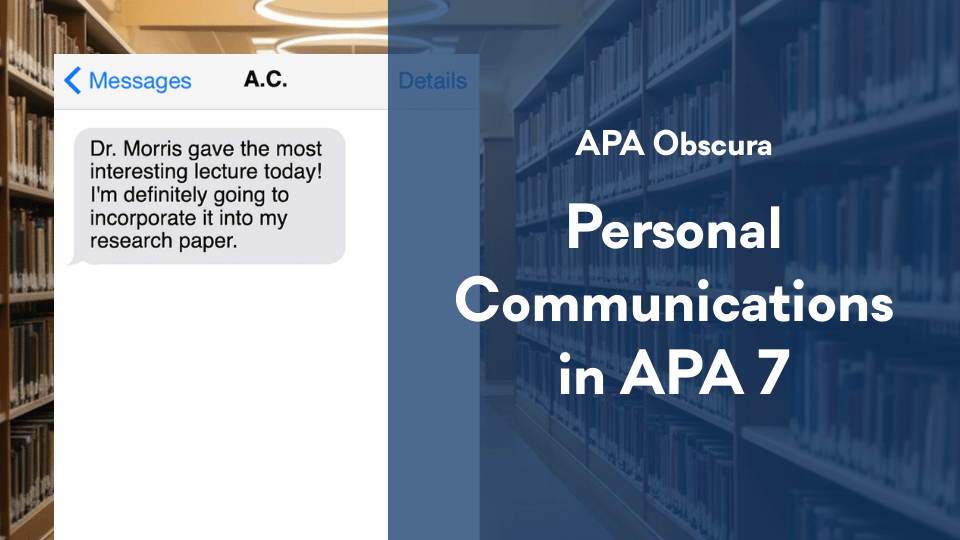
But what if they don’t have access to one or more references? Sources like a personal interview, text message, or an unrecorded classroom lecture can be viable, even if your reader is unable to view them.
The APA categorizes these types of references as “personal communications,” and they are treated much differently than other references in your paper. Most notably, references in this category do not appear on your reference page; they are only cited in the body of your paper.
What types of sources are considered personal communications?
According to the APA, any reference that cannot be retrieved by your reader qualifies as personal communications. In addition to personal interviews, text messages, and unrecorded classroom lectures, examples of personal communications include:
- E-mails
- Telephone conversations
- Letters
- Unarchived posts in discussion groups and online message boards
- Unrecorded speeches
In a nutshell, if a source cannot possibly be read, heard, or otherwise viewed by your reader, consider it personal communications.
How to handle personal communications in your paper
Since you won’t include any personal communication on your reference page, your in-text citation will do all the heavy lifting. In your citation, the APA says you should include the initials and surname of the communicator (essentially, the author) and an “as exact a date as possible” of when the communication took place.
Let’s say a professor – we’ll call him Dr. Zachary Morris – gave a particularly insightful lecture on sasquatch habitats, a lecture that wasn’t recorded and wasn’t heavily based on previously published research. While Dr. Morris’ original thoughts won’t earn him a spot on your reference page, you’ll still cite his lecture when you refer to it in your paper.
The parenthetical in-text citation would look like this:
(Z. Morris, personal communication, October 29, 2025)
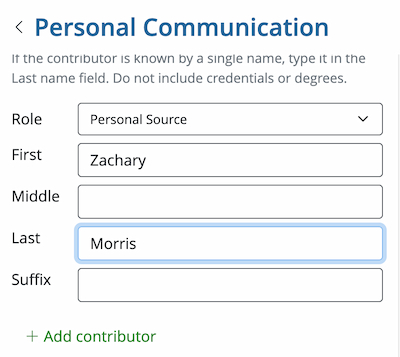
Of course, if you’re using PERRLA to write your paper and manage your references and citations, it will handle the personal communications reference type automatically. The reference you create with PERRLA won’t be added to your reference page, but you’ll still be able to cite it in your research paper or discussion post whenever necessary:
Pro Tip: Only use a Personal Communication citation when it is impossible to retrieve your reference information elsewhere. If Dr. Morris’ lecture was based on a journal article, it would be more appropriate to cite the journal article itself.
We’ll see you again soon for another deep dive into the great lesser-known! Until then, don’t forget PERRLA has all of your formatting covered (even the obscure stuff).