

Finding good sources is more than just locating information. It’s about locating the right information: sources that are credible, relevant, and appropriate for academic writing. That combination requires more judgment than most students expect the first time they sit down to research a topic.
This guide covers how to find quality sources, how to evaluate what you find, and a few strategies that make the whole process faster and more productive.
Start with a focused topic (but not too focused)
Most students begin researching before they’ve fully narrowed down their topic, and that’s a good thing. In the early stages of research, it’s common to read broadly, take more notes than you’ll need, and gradually zero in on what your paper is actually going to argue.
The risk is getting attached to sources that don’t fit your final topic. A piece of research can be genuinely interesting and still not belong in your paper. If it doesn’t support your argument, let it go, or save it for a future assignment. A paper strengthened by fewer, more relevant sources is almost always better than one padded with loosely related material.
A useful rule of thumb: after a first draft, most papers can be tightened significantly by removing anything that isn’t directly advancing the central argument.
Peer-reviewed sources vs. everything else
For most academic papers, peer-reviewed sources are the gold standard. A peer-reviewed article has been evaluated by other experts in the field before publication, meaning the research has been scrutinized for methodology, accuracy, and contribution to the field.
Not every source needs to be peer-reviewed. News articles, government publications, organizational reports, and credible websites all have legitimate roles in academic writing. But when your paper makes a factual or empirical claim, a peer-reviewed source is usually the strongest support you can offer.
When your professor says “academic sources” or “scholarly sources,” they almost always mean peer-reviewed journal articles and academic books. As always, when in doubt, ask.
Where to look for quality sources
Academic databases
Academic databases are the most reliable place to find peer-reviewed sources. If your institution gives you access to any of the following, start there:
- JSTOR – strong for humanities and social sciences. Many articles are freely accessible; others require institutional access.
- PubMed – the go-to database for biomedical and life sciences research. Free and comprehensive.
- CINAHL – essential for nursing and allied health students. Indexes nursing and health literature specifically.
- EBSCO and ProQuest – broad, multi-discipline databases your library may provide access to.
- Google Scholar – although technically an academic search engine and not a database, it is free, widely accessible, and a good starting point for almost any topic. Use it to find articles, check citation counts, and locate PDFs.
If you’re not sure what databases your institution provides, your library’s website will have a list, and a reference librarian can point you in the right direction faster than almost any search engine.
Your university library
Libraries are one of the most underused research resources available to students. Beyond physical books and journals, most academic libraries provide:
- Access to databases and digital archives not available for free online
- Interlibrary loan services that can get you articles and books from other institutions
- Reference librarians who specialize in helping researchers find sources. A reference librarian can often help you find in 15 minutes what might take you two hours to locate on your own. They’re a resource most students never think to use.
Government and organizational websites
For data, statistics, policy information, and authoritative overviews, government and established organizational websites are often excellent sources. Government (.gov) and educational (.edu) websites are often reliable sources because they are produced by established institutions. However, students should still evaluate the author, publication date, evidence, and purpose of the specific page they are using.
Examples include the CDC, NIH, Census Bureau, Department of Education, and similar agencies. For many research topics – particularly in health, social sciences, and public policy – government sources provide data that no other source can match.
The internet, used carefully
General internet searches can be a starting point, but most of what comes up in a Google search isn’t appropriate for academic citation. Blogs, opinion pieces, social media posts, and user forums rarely meet the standards academic writing requires.
A few tips for getting more out of Google when you do use it:
- Use quotation marks around a phrase to search for that exact wording: “evidence-based nursing practice”
- Add site:.gov or site:.edu to your search to limit results to government or educational sites
- Use a minus sign before a word to exclude results containing it: nursing -travel will filter out travel nursing results
- Try Google’s Advanced Search options to filter by date, domain, or region
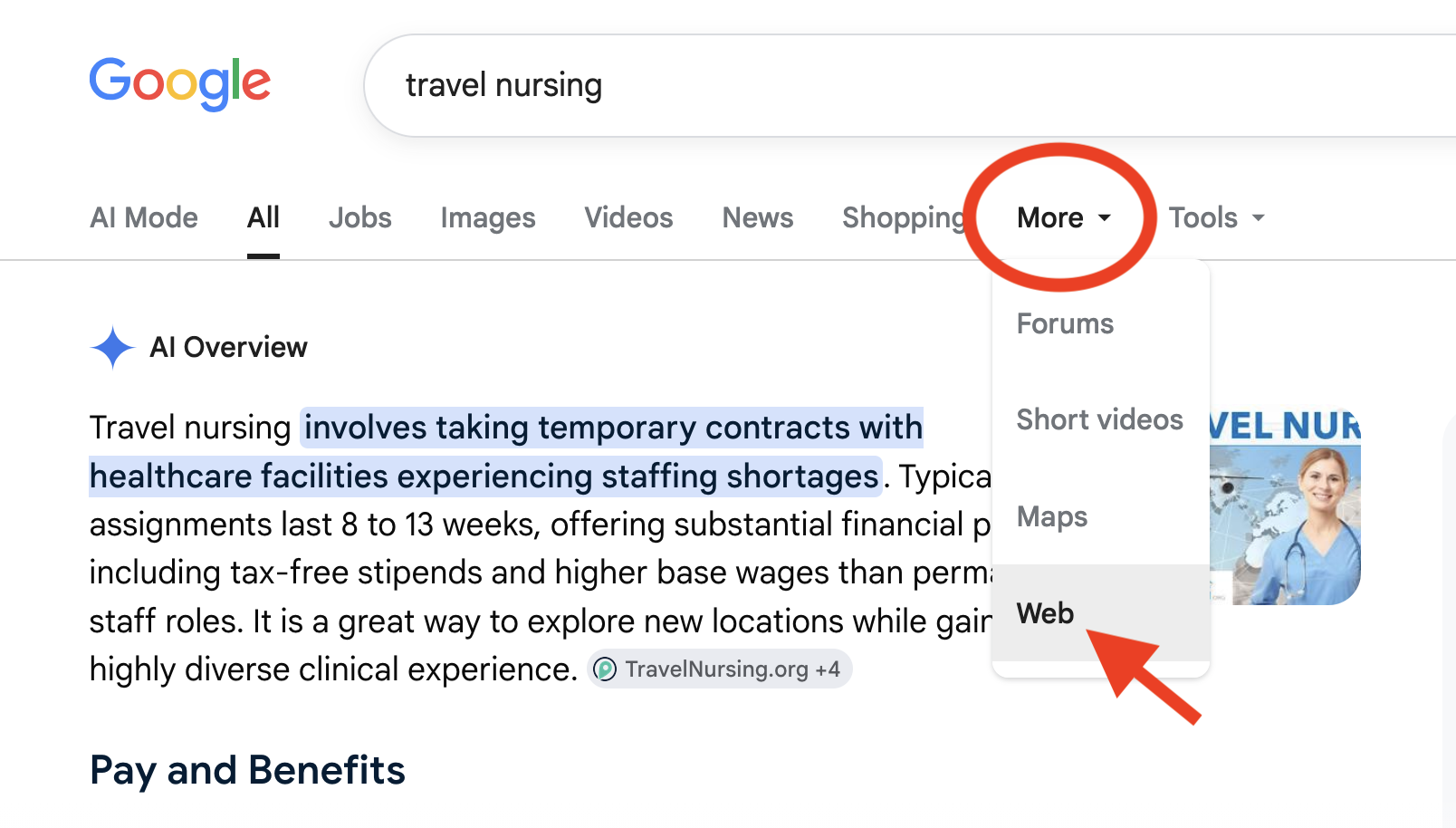
- Turn off AI Overviews: Google’s AI-generated summaries at the top of search results can be convenient for casual searches, but for academic research they’re a distraction at best and potentially misleading at worst. To hide them, click “More” under the search bar, then select “Web” to switch to a traditional results view that filters out AI Overviews
A word on Wikipedia
Wikipedia is a useful tool for getting a quick overview of a topic or identifying key concepts, terms, and related issues. It’s also a good place to find sources: the references and external links at the bottom of a Wikipedia article can point you toward legitimate academic material.
What Wikipedia is not is a citable source for academic papers. Because its entries can be edited by anyone, it doesn’t meet the standards of reliability that academic writing requires. Use it to orient yourself, then follow the trail to primary and peer-reviewed sources.
How to evaluate a source before you use it
Not every source you find will be worth using. Before committing to a source ask yourself these questions:
- Currency: When was it published? For most academic topics, more recent sources are preferable. For historical or foundational topics, older sources may be appropriate or even essential.
- Relevance: Does this source actually address your topic, or are you stretching to make it fit? A source that requires significant explanation to connect to your argument may not belong.
- Authority: Who wrote it, and what are their credentials? Is the source published by a reputable journal, institution, or organization?
- Accuracy: Is the information supported by evidence? Does the source cite its own sources? Can the claims be verified elsewhere?
- Purpose: Why was this written? To inform, persuade, sell, or entertain? Sources written to persuade or sell require extra scrutiny.
These five criteria, commonly known as the CRAAP Test, give you a reliable framework for evaluating almost any source type.
Gateway research: Let your sources find your sources
One of the most efficient research strategies that students rarely learn about is gateway research: using the bibliography or reference list of one good source to find others.
When you find a high-quality, peer-reviewed article or book that’s directly relevant to your topic, its reference list is essentially a curated collection of related sources that experts in the field have already vetted. Scan it for titles and authors that look promising, then search for those sources directly.
This approach has two advantages over starting from scratch with every search. First, it’s faster. You’re building on work that’s already been done. Second, the sources you find this way tend to be more relevant because they come from within the same scholarly conversation you’re trying to enter.
In Google Scholar, you can also use the “Cited by” link beneath an article to find newer sources that have referenced it. It’s a useful way to trace how research on a topic has developed over time.
Stay organized as you research
Keeping track of sources as you find them saves significant time later. The most common research mistake isn’t failing to find good sources; it’s finding them and then losing track of where they came from.
A few habits that help:
- Save or bookmark sources immediately rather than relying on browser history
- Note the full citation information: author, title, publication date, URL or DOI at the time you find the source, not after
- Keep a brief note on why each source is useful and what argument it supports
- Build your references as you research rather than all at once at the end
PERRLA’s Chrome Extension lets you create references and save research notes directly from your browser as you find sources, so the citation work happens in the moment rather than as a last-minute scramble. Try PERRLA free for 7 days – no credit card required.
Frequently Asked Questions
What makes a source credible for academic writing?
A credible academic source is typically peer-reviewed or published by a reputable institution, written by an author with relevant experience, supported by evidence, and free from obvious bias or commercial motivation. Government publications, academic journals, and university press books generally meet these criteria.
Can I use websites as sources in an academic paper?
Yes, with care. Government websites (.gov), educational institutions (.edu), and established professional organizations are generally acceptable. Personal blogs, opinion sites, and user-generated content generally aren’t appropriate as evidence for academic claims unless your assignment specifically asks you to analyze them.
How many sources do I need for a research paper?
It depends on the assignment. Follow your instructor’s requirements. As a general principle, the number of sources matters less than their quality and relevance. A paper built on five strong, directly relevant sources is usually stronger than one padded with 15 loosely related ones.
What is the difference between a primary and secondary source?
A primary source is original material: a research study, a historical document, a work of literature, raw data. A secondary source analyzes, interprets, or summarizes primary sources. Both have legitimate roles in academic writing, but some assignments specify which type they want.
What is Google Scholar, and is it reliable?
Google Scholar is a free search engine that indexes academic articles, books, theses, and conference papers. It’s a reliable starting point for finding scholarly sources, though not everything it indexes is peer-reviewed. Check whether an article comes from a peer-reviewed journal before citing it as a scholarly paper.