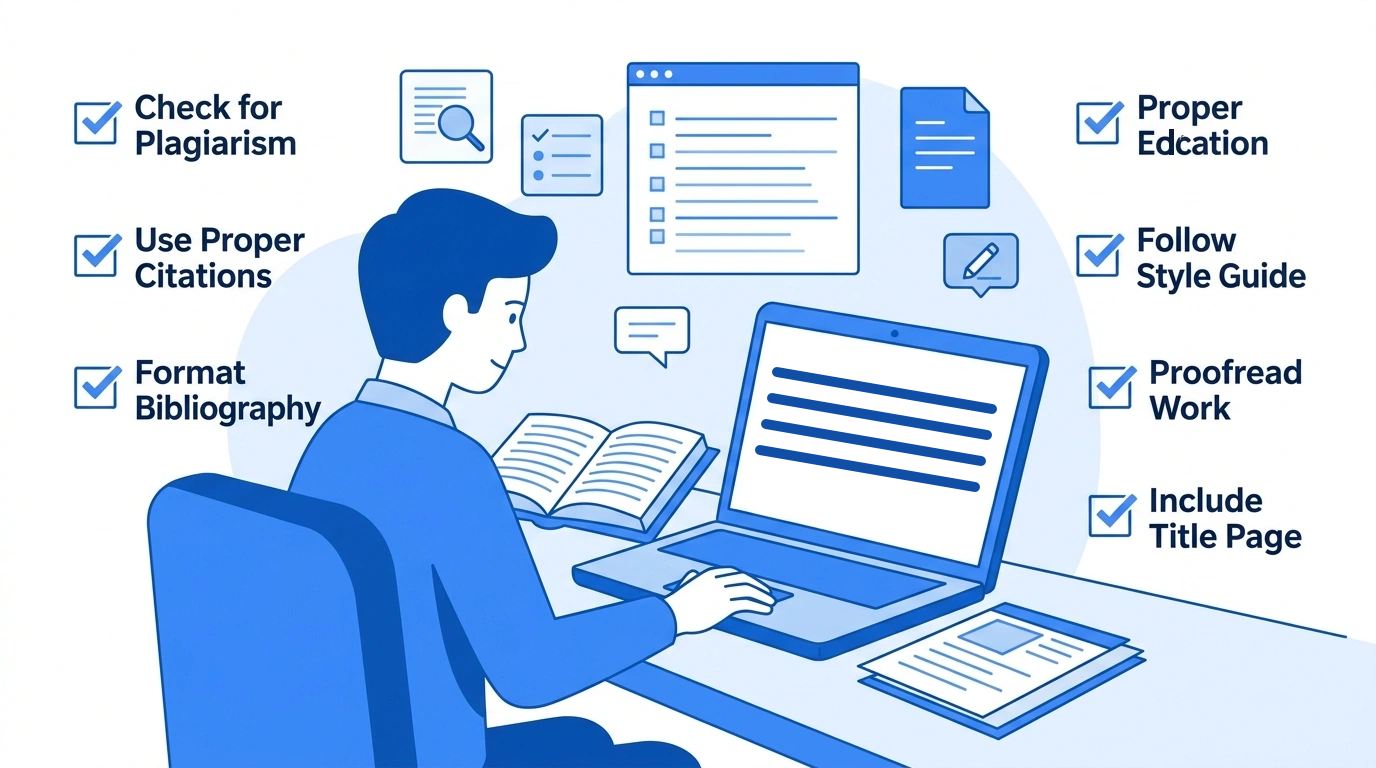
The Essential Guide to Academic Citations & Why They Matter
Nobody grows up dreaming about formatting citations. It's the broccoli of academic writing you know it's good for you, but you're not excited about it. Still, whether you're a first-semester freshman or a Ph.D. candidate, knowing how to cite sources properly is the difference between a paper that looks professional and one that looks like you cut corners.
Here's the breakdown without the fluff.
Why Citations Matter
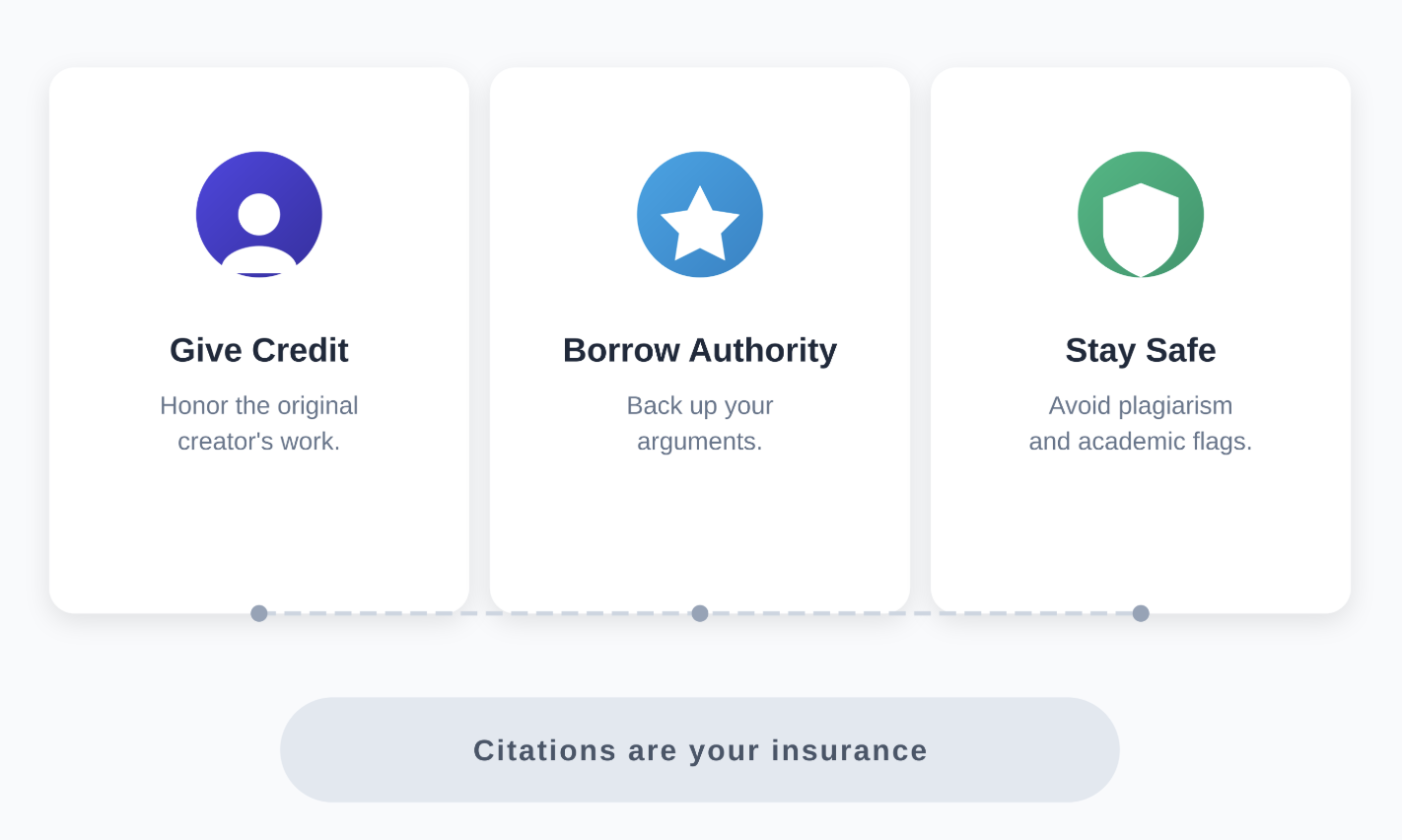
It isn't just busy work. You cite for three reasons: to give credit to the person who did the work, to borrow their authority for your argument, and pragmatically to keep yourself from getting flagged for plagiarism. Even unintentional plagiarism can blow up a semester. Citations are your insurance.
The Two-Part System
Academic citations work in pairs. The in-text citation is the "X marks the spot" in your paper. The reference list entry is the map. You need both. If you cite something in the text, it has to be in the reference list. If it's in the reference list, it has to be cited in the text. No orphans.
In-Text Citations: The Quick Reference
In-text citations are the notes you drop right in the body of your paper. The format depends on the style, but the idea is the same: point the reader to the source.
APA Style
APA (American Psychological Association) is standard for social sciences, education, and business. It uses the author's last name and year.
Paraphrasing:
Recent research (Johnson, 2024) shows students using formatting tools spend 40% less time on citations.
Or:
Johnson (2024) found that students using formatting tools spend 40% less time on citations.
Direct quotes:
Include a page number:
One researcher noted that "citation anxiety is a real phenomenon affecting student performance" (Johnson, 2024, p. 47).
Multiple authors:
- Two authors: (Smith & Jones, 2025)
- Three or more: (Williams et al., 2024)
"Et al." is Latin for "and others." It saves you from listing everyone every time.
MLA Style
MLA (Modern Language Association) is for humanities. It uses page numbers instead of years.
Basic format:
The character's transformation represents a cultural shift (Martinez 234).
Or:
Martinez argues that the character's transformation represents a cultural shift (234).
Direct quotes:
Just author and page number:
"The transformation happens gradually, then all at once" (Martinez 234).
No page numbers? Use the author's name: (Martinez).
Turabian Style
Turabian is a student version of Chicago style. It has two systems: notes-bibliography (footnotes/endnotes) and author-date.
Notes-bibliography: Use superscript numbers in your text¹ that link to footnotes.
Author-date: Similar to APA: (Chen 2025, 42).
Special Situations
No Author
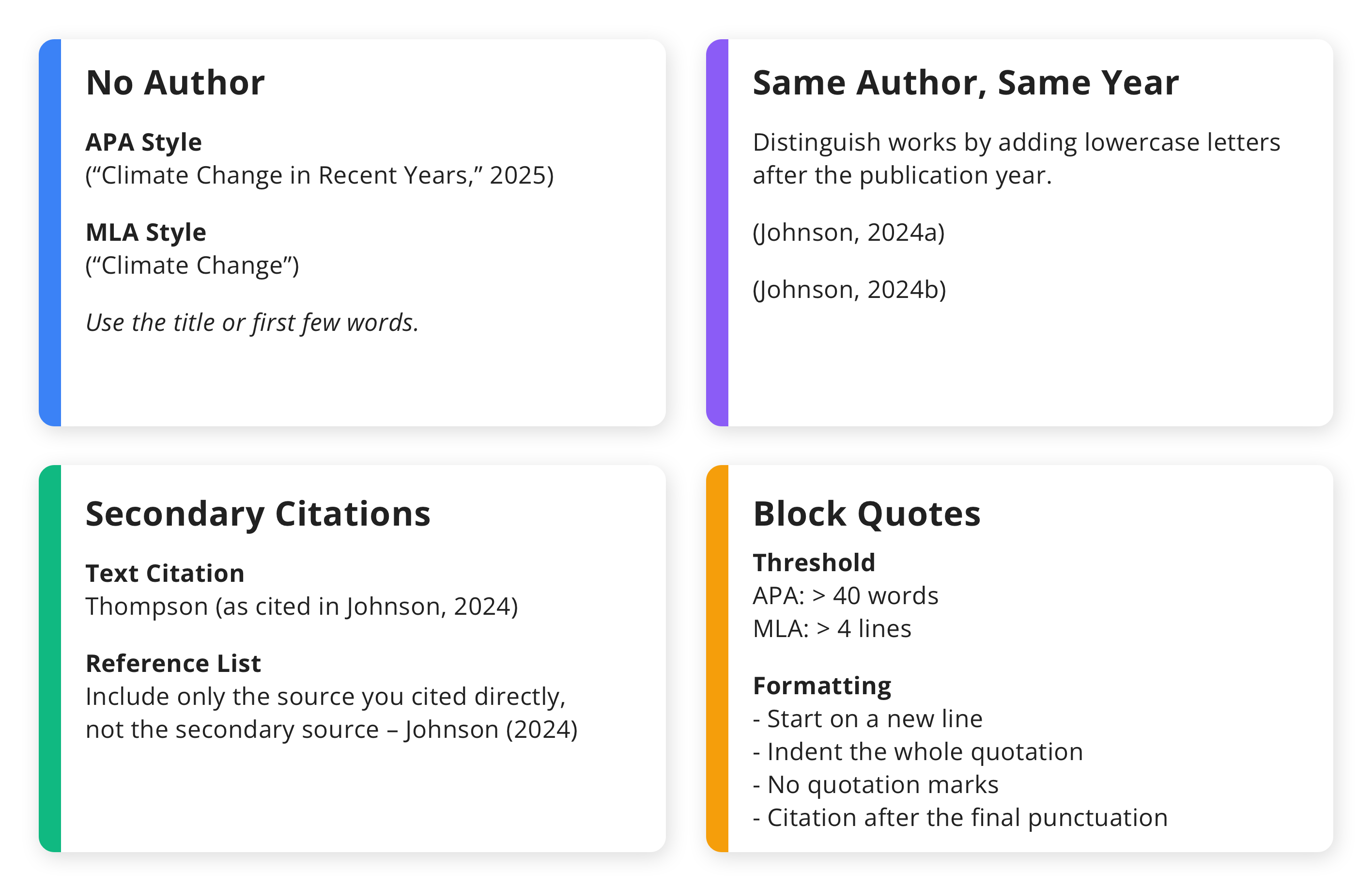
Use the main title for APA or just the first few words of the title for MLA:
APA: ("Climate Change Effects on," 2025)
MLA: ("Climate Change Effects")
Multiple Works by the Same Author
If citations for multiple works would look the same (i.e., they have the same author and publication dates), then add a letter behind the publication date:
(Johnson, 2024a) and (Johnson, 2024b)
Secondary Citations
Try to avoid this. Find the original. If you can't:
APA: Thompson's study (as cited in Johnson, 2024) revealed…
Only Johnson (2024) goes in the reference list.
Block Quotes
For quotes over 40 words (APA) or 4 lines (MLA), start a new line, indent the whole quote, skip the quotation marks, and put the citation after the final punctuation.
Building Your Reference List
Your reference list (or Works Cited in MLA, or Bibliography in Turabian) is the full map. Every source gets an entry.
Basic Principles
Alphabetical order. By author's last name.
Hanging indent. First line at the margin, rest indented. This is annoying to do manually, which is why tools like PERRLA for Word exist.
Complete information. Give readers everything they need to find the source.
APA Format
Journal article:
Martinez, A. R. (2024). The impact of citation tools on academic performance. Journal of Educational Technology, 45(3), 112-128. https://doi.org/10.1234/jet.2024.112
Book:
Thompson, K. L., & Williams, P. J. (2025). Academic writing in the digital age (3rd ed.). University Press.
Website:
Johnson, M. (2024, January 15). Understanding modern citation practices. Academic Resources Center. https://www.example.com/citations
APA uses DOIs (Digital Object Identifiers) when available they're more stable than URLs.
MLA Format
Journal article:
Martinez, Ana Rosa. "The Impact of Citation Tools on Academic Performance." Journal of Educational Technology, vol. 45, no. 3, 2024, pp. 112-28.
Book:
Thompson, Karen Lee, and Patricia J. Williams. Academic Writing in the Digital Age. 3rd ed., University Press, 2025.
Website:
Johnson, Michael. "Understanding Modern Citation Practices." Academic Resources Center, 15 Jan. 2024, www.example.com/citations.
MLA follows a "container" system showing where the piece lives (in a journal, on a website).
Turabian Format
Author-date:
Martinez, Ana R. 2024. "The Impact of Citation Tools on Academic Performance." Journal of Educational Technology 45 (3): 112-128.
Notes-bibliography:
Ana R. Martinez, "The Impact of Citation Tools on Academic Performance," Journal of Educational Technology 45, no. 3 (2024): 112-128.
Common Mistakes
Citing too little. When in doubt, cite it. You need citations for paraphrases and summaries, not just direct quotes.
Citing too much. Citing every sentence makes your paper a choppy list of other people's ideas. Cite the source when you introduce the idea, then discuss it.
Inconsistency. Pick a style and stick to it. Don't switch between APA and MLA.
Outdated guides. Style guides change. APA 7th edition is different from the 6th. MLA 9th is different from the 8th. Use the current version. PERRLA's APA 7 and MLA 9 products stay updated, which helps when you have deadlines.
Mismatched lists. You cite Smith (2024) in the text but the reference list says Smithson (2024). Cross-check before submitting.
Tricky Source Types
Social Media
You can cite tweets and TikTok in academic papers.
APA: National Science Foundation [@NSF]. (2024, March 10). New research reveals surprising connections between sleep and memory [Tweet]. Twitter. https://twitter.com/NSF/status/123456789
Interviews
APA: Personal communications are cited in-text only: (J. Smith, personal communication, February 12, 2025).
MLA: Include in Works Cited: Smith, Jennifer. Personal interview. 12 Feb. 2025.
YouTube and Podcasts
APA: LastName, F. M. [Username]. (2024, January 5). Title of video [Video]. YouTube. https://www.youtube.com/watch?v=xxxxx
Government Documents
Often organizational:
APA: National Institute of Health. (2024). Annual research report. U.S. Department of Health and Human Services. https://www.nih.gov/report2024
Use Technology
Formatting citations manually is tedious and error-prone. Tools like PERRLA Online or the Word add-in handle the complexity. You enter the source info once, and the software formats it correctly in both places including those hanging indents. The version history feature also timestamps your work, which is useful if questions come up later.
Build Habits
Don't leave citations for the end.
Collect info immediately. Don't just bookmark. Capture author, title, date right away. You won't remember later.
Cite as you draft. Do it when you use the source. It prevents accidental plagiarism.
Use a system. Whether it's PERRLA, note cards, or a spreadsheet – stick to it!
Ask for help. Your professor or librarian can answer questions. It shows you care.
The Bottom Line
Citations aren't fun, but they don't have to be a nightmare. Understand the two-part system (in-text plus reference list). Know your style rules (APA, MLA, Turabian). Apply them consistently.
You don't need to memorize every rule. That's what guides and tools are for. You just need to know why they matter and have a system to get them right.
.avif)
.avif)