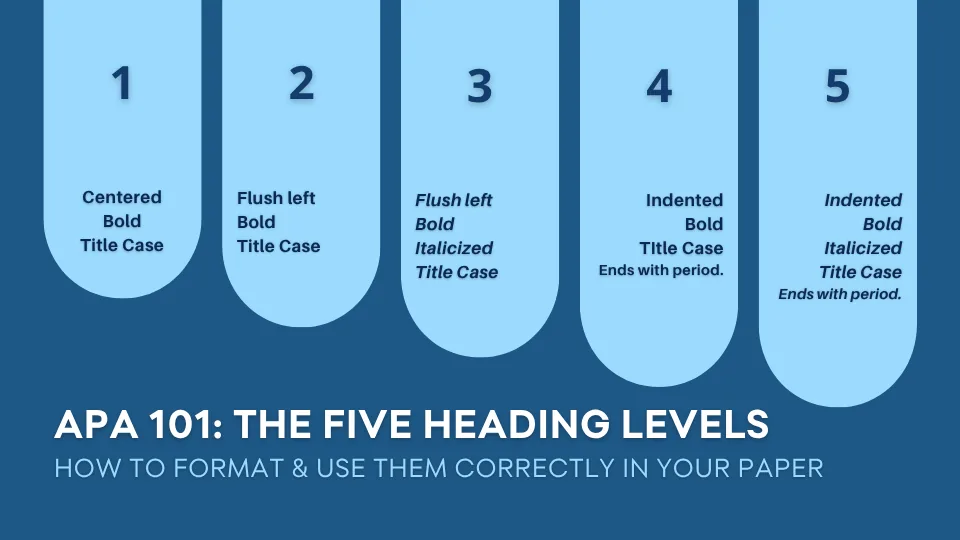
APA 7 gives you five heading levels to work with – and each one has its own formatting rules. But knowing how they look is only half the job. This post covers how to format all five levels correctly and how to use them well, including heading hierarchy, the symmetry rule, and why your introduction never gets a heading.
B
Brian @ PERRLA · Published June 8, 2026
Headings are one of those APA elements that look clear and simple until you’re staring at a half-finished paper trying to remember whether Heading 3 is bold or italicized … or maybe both?
The APA format gives you five heading levels to work with. Most papers only use one or two of them, but knowing all five – and understanding how to use them correctly – keeps your paper organized and your professor happy. Here’s what you need to know.
What are APA headings?
Headings are labels that divide your paper into sections. Think of them as mini-titles for each part of your paper. They signal to the reader what’s coming and help organize your argument into logical chunks.
One important distinction: headings are not the same as the header at the top of each page. The page header contains your page number (and, for professional papers, a running head). Headings live inside the body of your paper, at the start of each section.
Headings are specifically useful in longer papers with multiple sections or supporting points. For a short paper – say, two or three pages – headings may not be necessary at all. When in doubt, check your assignment instructions.
The five APA headings levels
APA 7 uses five levels of headings, numbered 1 through 5. Each level has its own distinct formatting, and they work as a hierarchy – Heading 1 is the top level, Heading 2 is a subdivision of Heading 1, and so on down the line.
Heading 1
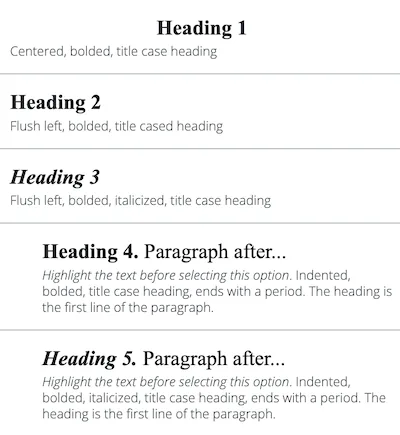
Centered, bold, Title Case. Goes on its own line, with the paragraph text beginning on the next line.
Heading 1 is your top-level section label. In a paper about cryptid migration patterns, a Heading 1 might read: Migration Patterns of North American Cryptids.
Heading 2
Bold, flush left, Title Case. Goes on its own line.
Heading 2 subdivides a Heading 1 section. Under the Heading 1 above, a Heading 2 might read: Sasquatch Sightings in the Pacific Northwest.
Heading 3
Bold and italicized, flush left, Title Case. Goes on its own line.
Heading 3 subdivides a Heading 2 section. It’s less common in undergraduate papers but appears in longer or more complex research: Seasonal Migration Trends.
Heading 4
Bold, indented 0.5 inches, Title Case, ends with a period. The paragraph text starts immediately after the heading on the same line – not on the next line.
Example: Summer Range Expansion. Sightings during summer months suggest…
Heading 5
Bold and italicized, indented 0.5 inches, Title Case, ends with a period. Like Heading 4, the paragraph text follows immediately on the same line.
Example: Pacific Coast Sightings. Reports from coastal regions indicate…
Headings 4 and 5 are rare in standard undergraduate papers. If you’re writing a thesis or a complex research paper with deeply nested sections, you’ll encounter them. Otherwise, Heading 1 and Heading 2 will handle most of what you need.
How to use APA headings correctly
Knowing how each heading looks is only half the job. Using them correctly, in the right places and in the right order, is where a lot of students run into trouble.
Always start with Heading 1
Your main sections always get Heading 1. You don’t start with Heading 2 simply because a section feels less important. Hierarchy is determined by structure, not significance.
Only go deeper when you need to subdivide
Move to Heading 2 only when you need to break a Heading 1 section into multiple distinct parts. Move to Heading 3 only when you need to break a Heading 2 section into parts. Don’t skip levels – jumping from Heading 1 directly to Heading 3 isn’t permitted in the APA format.
Never use just one heading at any level
If a section only has one subdivision, it doesn’t need a subheading at all. Just fold that content into the parent section. The rule of thumb: if you’re going to use Heading 2 under a Heading 1, you need at least two Heading 2s under that same Heading 1. A single subheading under any section is a signal that the content doesn’t actually need to be subdivided.
Keep parallel headings similarly phrased
Headings at the same level should follow a consistent grammatical pattern. If one Heading 2 reads Types of Cryptids, the others under the same Heading 1 should follow a similar structure: Characteristics of Bigfoot or History of Sightings work well. Bigfoot Species or Sightings and Their History break the parallel structure and make the paper feel inconsistent.
Your introduction doesn’t get a heading
This one catches a lot of students off guard: the introduction section of an APA paper does not get a Heading 1 label. APA assumes the opening paragraphs of your paper are introductory, so you just start writing. The first heading in your paper should be the first major section after the introduction, not the introduction itself.
Adding headings in PERRLA
PERRLA handles heading formatting automatically. In PERRLA Online and both the Word and Google Docs add-ins, you can apply any of the five heading levels with a single click – no manual formatting required.
APA 7 has five heading levels, numbered 1 through 5. Each level has its own distinct formatting. Most student papers only use Heading 1 and Heading 2.
Do I need to use all five APA heading levels?
No. You only use as many levels as your paper’s structure requires. Most undergraduate papers use only Heading 1 and Heading 2. Headings 3 through 5 are typically reserved for longer, more complex papers like theses or dissertations.
Can I skip heading levels in APA?
No. APA headings must be used in order. You can’t jump from Heading 1 to Heading 3 without a Heading 2 in between. Each level is a subdivision of the one above it, and skipping levels disrupts that hierarchy.
Does the introduction get a heading in APA?
No. The introduction section of an APA paper does not get a heading. APA assumes the first paragraphs of a paper are introductory, so you begin writing without a label. The first heading in your paper should be the first major section that follows the introduction.
What is the difference between Heading 1 and Heading 2 in APA?
Heading 1 is centered, bold, and in Title Case. Heading 2 is bold, flush left, and in Title Case. Structurally, Heading 1 marks your main sections, and Heading 2 marks subdivisions within those sections.
What is heading symmetry in APA?
Heading symmetry means that headings at the same level should be grammatically parallel – similarly phrased and structured. It also means you should never use just one subheading under a section: if you use Heading 2 under a Heading 1, you need at least two Heading 2s in that section.
An annotated bibliography follows standard APA reference formatting, then adds a short paragraph below each entry summarizing and evaluating the source. This guide covers what annotations include, how to format the…
Citing a TikTok or Instagram Reel in APA 7 means treating the caption as the title – the first 20 words, preserving the original spelling and capitalization, hashtags and all. This post covers the full format, how to…
Knowing how to format the five APA heading levels is only half the job. This post covers the practical side: when headings are actually required, why your introduction never gets one, how many levels your paper needs…
PERRLA formats the whole paper in APA 7, MLA 9, and Turabian 9, from the title page to the last reference.