For a typical print book by a known author, you need four core pieces of information to build your MLA 9 Works Cited entry: the author’s name, the title, the publisher, and the publication year. Put them together in that order in your Works Cited entry, and use the author’s last name and a page number when you cite in the text of your paper.
Here’s what a standard Works Cited entry for a book looks like:
Coleman, Loren. Mothman and Other Curious Encounters. Paraview Press, 2002.
And in your paper, the in-text citation looks like this:
(Coleman 47)
With the basic case covered, let’s delve into the variations you’re most likely to encounter.
The Works Cited Entry, One Author
Every MLA Works Cited entry for a book follows this structure:
Last, First. Title of Book. Publisher, Year.
A few quick notes: the author’s last name comes first, and the title is italicized. A comma separates the publisher from the publication year, and the entry ends with a period.
Two Authors
Only the first author’s name is reversed. The second is written first name first.
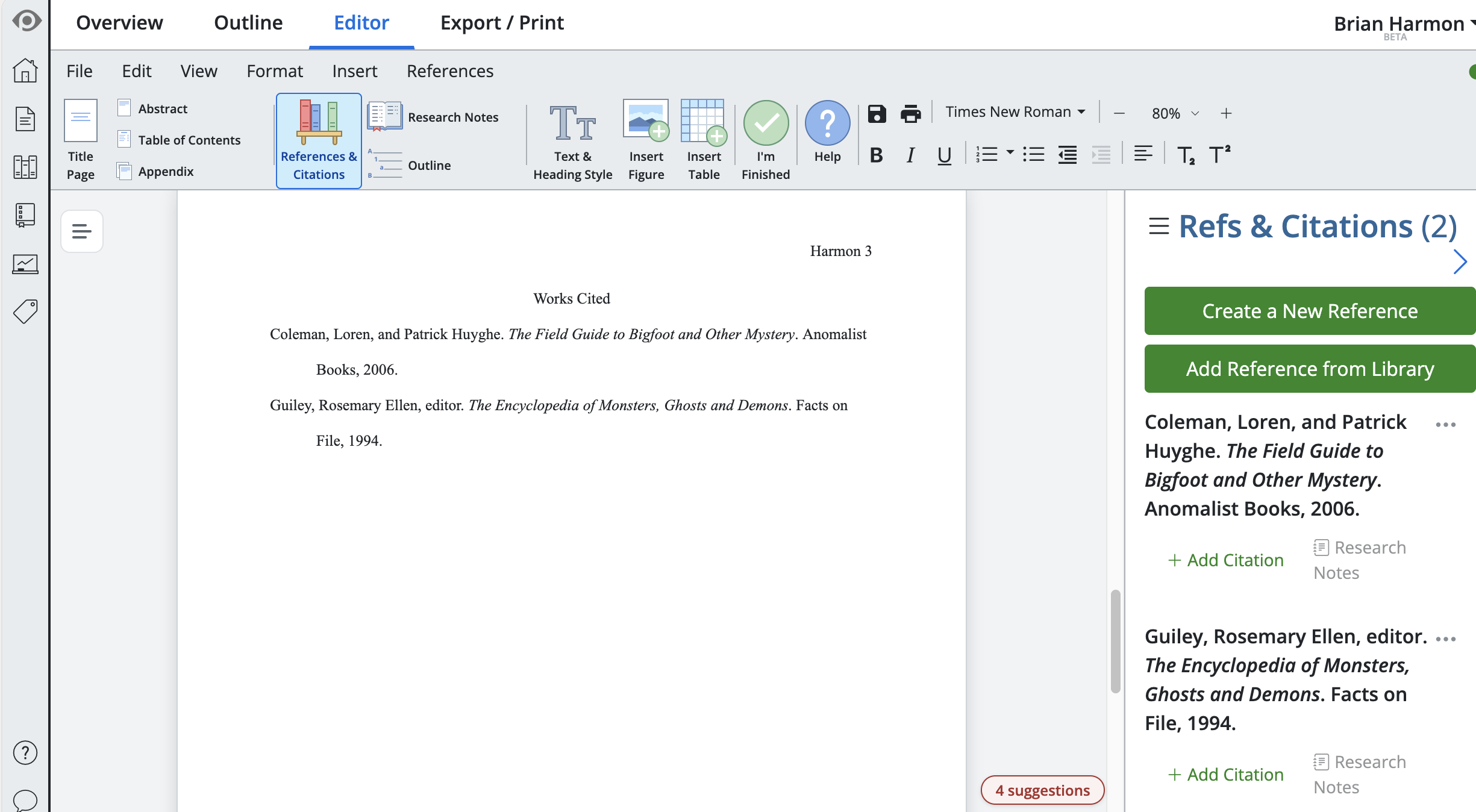
Coleman, Loren, and Patrick Huyghe. The Field Guide to Bigfoot and Other Mystery Primates. Anomalist Books, 2006.
In-text citation: (Coleman and Huyghe 112)
Three or More Authors
List only the first author, then “et al.”
Coleman, Loren, et al. Cryptozoology A to Z. Fireside, 1999.
In-text citation: (Coleman et al. 34)
No Author
Start the entry with the title. In the in-text citation, use a shortened version of the title in italics – starting from the beginning of the Works Cited entry so readers can find it in your list.
The Mothman Prophecies: Collected Accounts from Point Pleasant. Cryptid Press, 2018.
In-text citation: (Mothman Prophecies 22)
An Edition Other Than the First
Add the edition after the title.
Coleman, Loren. Mothman and Other Curious Encounters. 2nd ed., Paraview Press, 2008.
In-text citation: (Coleman 34)
An Edited Book
For a book with one editor, use “editor” after the name. For two or more editors, use “editors.”
Guiley, Rosemary Ellen, editor. The Encyclopedia of Monsters, Ghosts and Demons. Facts on File, 1994.
In-text citation: (Guiley 88)
A Translated Book
To emphasize the original author:
Keel, John A. The Mothman Prophecies. Translated by Maria Santos, Tor Books, 2002.
In-text citation: (Keel 59)
No Page Numbers (E-Books)
If you’re citing an e-book with no stable page numbers, don’t use your device’s location numbers. Just cite the author’s last name:
(Coleman)
If the book has stable chapter or section numbers, you can use those instead:
(Coleman, chap. 3)
How PERRLA Handles It
In PERRLA, select MLA as your format when you start your paper. When you add a book source, PERRLA builds the Works Cited entry and formats the in-text citation automatically – author name, title, publisher, year, punctuation, and all. You just fill in the source details or input an ISBN number.
PERRLA’s 7-day free trial gives you full access to MLA, APA, and Turabian – no credit card required. Start your paper, add your sources, and let PERRLA handle the formatting from there.
Frequently Asked Questions
Do I need a page number in every MLA in-text citation?
Include a page number when you quote or refer to a specific passage in a paginated book. If you’re discussing the work as a whole, a page number may not be necessary. For e-books without stable page numbers, don’t use device-specific location numbers. If the text provides stable numbered chapters or sections, you may be able to use those to identify the passage.
Do MLA 9 in-text citations use “p.” before page numbers?
No. MLA in-text citations don’t use “p.” or “pp.” – just the number: (Coleman 47).
What if two sources have authors with the same last name?
Include the authors’ first initials to distinguish them – for example (L. Coleman 47) and (R. Coleman 82). If the authors also share the same initials, use their full first names instead.
How do I cite a book I read online?
It depends on where and how you accessed it. An e-book read through an e-reader app may require an e-book version designation. A book accessed through a website or online database may require the platform or database name and a URL or DOI. Follow the MLA format appropriate to the version you actually consulted.
Does it matter which edition of a book I cite?
Yes. Cite the edition you actually used. If it’s not the first edition, include the edition number after the title in the Works Cited entry.