

If you’ve ever searched for MLA heading formatting rules expecting something like APA’s five-level system, you’ve probably noticed that MLA 9 doesn’t have one, and that’s not a gap in your search results. It’s the answer.
MLA 9 does not prescribe a single, fixed format for headings. It provides guiding principles – descending prominence, consistent styling – and leaves the specifics to the writer or instructor. If you were expecting clear rules, that can be both freeing and confusing.
Here’s what the MLA says, and what to do with it.
Do MLA papers need headings?
Not necessarily. MLA papers do not require headings simply because they follow MLA style. Headings can be useful when a paper is long or complex enough that readers benefit from clear section labels. A shorter essay or literary analysis often flows better as continuous prose without them.
The first question to ask is whether your instructor requires or recommends headings. If they do, follow their guidance. If the assignment doesn’t address it, consider whether your paper’s length and structure actually call for them.
What MLA 9 actually says about headings
The MLA Style Center describes headings in terms of principles rather than a prescribed format:
- The paper title is the first level of heading. It is centered. Internal headings are separate from this.
- Internal headings should be flush left. They signal hierarchy through font styling and size – boldface or larger type for prominence, italics or smaller type for subordination.
- Be consistent. Whatever format you choose for headings at the same level, apply it consistently throughout the paper.
- Each internal heading level should have at least two instances. If a level has only one heading, that level probably isn’t needed.
- Avoid numbering headings unless numbered sections are conventional in your discipline or required by your instructor.
Beyond these principles, MLA defers to the writer’s judgment and the instructor’s requirements.
A format that works
Since MLA doesn’t mandate a specific style, here’s how PERRLA formats MLA headings – an approach that reflects MLA’s core principles of descending prominence, flush-left internal headings, and consistent styling:
- Paper title: Centered – this is the first level of heading in MLA
- Level 1: Flush left, bold, 14 pt., title case
- Level 2: Flush left, bold italic, 14 pt., title case
- Level 3: Flush left, 14 pt., title case – no bold or italic; the absence of styling signals subordination
- Level 4: Flush left, bold, 12 pt., title case
- Level 5: Flush left, italic, 12 pt., title case
The shift from 14 pt. to 12 pt. at Level 4 is how the hierarchy continues to signal descending prominence as the levels increase. Most papers won’t need more than two or three internal heading levels – if your paper requires four or five, it’s likely a longer research project, thesis, or dissertation.
Whatever format you use, apply it consistently. If your instructor has specified a different format, follow theirs.
Capitalization in MLA headings
The MLA Style Center says to capitalize headings like the titles of works, which means headline-style capitalization. Capitalize the first and last word of the heading and all major words in between.
Do not capitalize:
- Articles: a, an, the
- Coordinating conjunctions: and, but, for, nor, or, so, yet
- Prepositions under five letters: at, by, for, in, of, on, to, up, etc.
This is the opposite of APA’s sentence case for headings, which only capitalizes the first word and proper nouns. If you write in both formats, it’s a distinction worth keeping in mind.
MLA heading examples
Here’s what a paper with three levels of internal headings might look like, using a paper on Mothman as an example:
Paper title (centered)
The Mothman Phenomenon: History and Interpretation
Level 1 (flush left, bold)
Historical Context of the Sightings
Level 2 (flush left, bold italic)
The 1966-1967 Wave of Reports
Level 3 (flush left, italic)
Eyewitness Accounts from Point Pleasant
Notice that only the paper title is centered. All internal headings are flush left, with styling changes signaling the hierarchy. The MLA Style Center also recommends leaving a blank line above and below each heading for readability.
Common MLA heading mistakes
- Centering internal headings – only the paper title is centered. Internal headings in MLA are flush left.
- Using sentence case instead of title case – MLA headings are capitalized like titles of works, not like APA headings
- Using only one heading at a level – MLA recommends that each internal heading level contain at least two headings. If a section has only one distinct subsection, consider incorporating that material into the parent section instead.
- Inconsistent formatting across heading levels – whatever styling you choose, apply it consistently throughout the paper.
- Numbering headings unnecessarily – MLA advises avoiding numbers and letters for headings unless numbering is conventional in your discipline or required by your instructor.
Formatting MLA headings in PERRLA
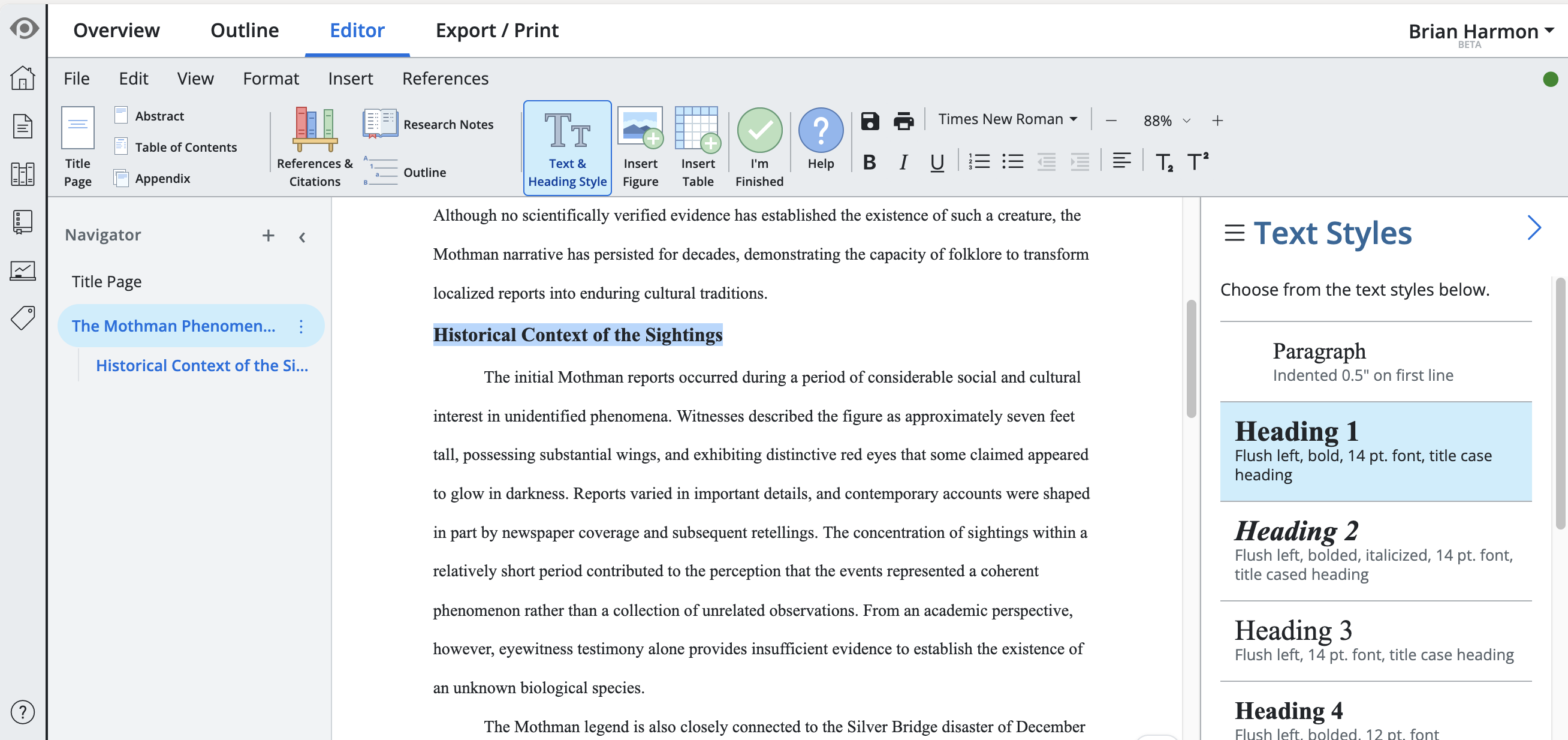
In PERRLA, heading styles are applied with a single-click from the Text & Heading Styles panel. Select your text, choose the heading level, and PERRLA applies consistent MLA-appropriate formatting automatically.
Try PERRLA free for 7 days – no credit card required.
Frequently Asked Questions
Does MLA format require headings?
No. MLA does not require internal headings. Headings can be useful when a paper is long or complex enough to benefit from clear section labels. Always follow your instructor’s guidance.
What format should MLA headings be in?
MLA 9 does not prescribe one fixed format for internal headings. The paper’s title is centered and serves as the first level of heading. Internal headings should be flush left and styled in descending order of prominence – for example, bold for the first level, bold italic for the second, and italic for the third. Whatever format you choose, apply it consistently.
Does MLA use title case or sentence case for headings?
Title case. MLA says to capitalize headings like the titles of works – capitalize the first and last word and all major words in between. Do not capitalize articles, short conjunctions, or short prepositions. This is the opposite of APA, which uses sentence case for headings.
Can you have just one subheading in an MLA section?
No. MLA recommends that each internal heading level contain at least two headings. If a section has only one distinct subsection, consider incorporating that material into the parent section instead.
Should MLA headings be numbered?
Generally, they should not. MLA advises avoiding numbers and letters for headings unless numbering is conventional in your discipline or required by your instructor.
Does the introduction get a heading in MLA?
Not necessarily. MLA does not require an “Introduction” heading. Many papers begin with introductory material before the first internal heading. If your paper’s organization calls for one, however, MLA does not prohibit it. Follow your instructor’s requirements.