Five Nursing Programs Tried PERRLA: Here’s What Happened
Five nursing programs ran full case studies with PERRLA, from a required rollout to one with no requirements at all. Here's what changed for faculty, students, and grades.
PERRLA/Blog/APA/PERRLA Now Offers Free Citation Guides for Over…
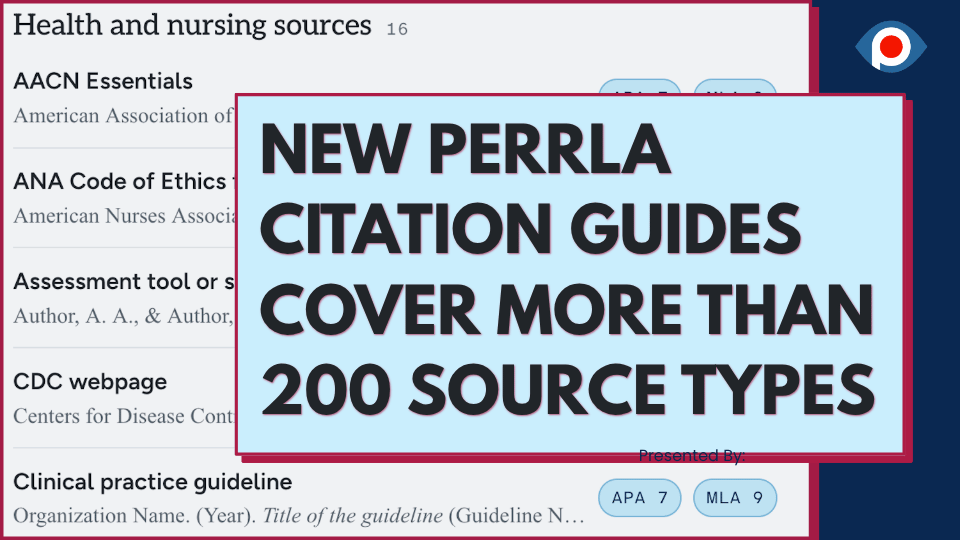
Citing a Cochrane review is not the same as citing a journal article. Citing a TikTok is not the same as citing a YouTube video. PERRLA's new citation guides hub currently has 245 source-specific guides – free, no account required – so you can get the format right for whatever you're actually citing.
PERRLA’s free citation guides hub now includes more than 200 guides covering APA 7 and MLA 9 source types across 10 categories with Turabian 9 guides soon to be added as the hub continues to grow.
Whether you need to cite a journal article, a government report, a TikTok video, or a Cochrane review, there’s a dedicated guide for it. What’s more, you don’t need a PERRLA account to use the guides. They’re free and open to everyone.
The hub is organized into 10 source categories, each covering the source types students encounter in their coursework. Every guide covers the same ground: the correct reference list format, in-text citation rules, examples, common mistakes, and a quick checklist.
Here’s a brief overview of each of the 10 categories and what’s inside each one:
Sixteen guides covering journal articles, magazine articles, newspaper articles, online news articles, op-eds, book reviews, translated articles, and more. The journal article guide alone covers DOI formatting, the 21-or-more-authors rule, article numbers, and the most common mistakes students make.
Sixteen guides covering books, e-books, audiobooks, edited books, chapters in edited books, anthologies, encyclopedias, dictionaries, Wikipedia, translated books, and multivolume works. If you’ve ever wondered whether to italicize a chapter title or where the edition number goes, the book guides have you covered.
Eleven guides covering webpages, blog posts, press releases, software, mobile apps, ChatGPT and other AI tools, and webpages with no author or no date. The webpage guide walks through four variations – individual authors, news site articles, organizational authors, and pages that change over time (like a population counter), explaining when to include a retrieval date.
Sixteen guides covering federal laws, congressional bills, executive orders, court cases, patents, treaties, constitutional amendments, state laws, and more. The U.S. Constitution, U.S. Supreme Court cases, and the Affordable Care Act each have their own dedicated guide.
Sixteen guides built specifically for nursing and health sciences students. This category covers CDC webpages, NIH and MedlinePlus pages, the DSM-5-TR, UpToDate articles, Cochrane reviews, clinical practice guidelines, HIPAA, the ANA Code of Ethics for Nurses, the AACN Essentials, drug guide entries, assessment tools, WHO reports, and state nurse practice acts.
If you’re in a nursing program, this category alone covers most of what you’ll cite in your coursework.
Eleven guides for sources that don’t fit neatly elsewhere: dissertations, master’s theses, preprints, conference presentations, class lectures and notes, lecture slides, poster presentations, interviews, personal communications, and unpublished manuscripts. The dissertation guide covers ProQuest dissertations, university repository dissertations, and unpublished copies – since the format changes depending on where the work is housed.
Eighteen guides covering YouTube videos, TED Talks, podcasts, podcast episodes, video podcasts, movies, documentaries, TV series, TV episodes, online videos, songs, albums, radio broadcasts, speeches, paintings and artwork, photographs, infographics, and advertisements.
Six guides for Facebook posts, Instagram posts and Reels, X (Twitter) posts, TikTok videos, LinkedIn posts, and Reddit posts.
Eight guides covering government reports, organizational reports, data sets, white papers, grants, brochures, equipment and apparatus, and tests and scales.
Five guides covering the Bible, the Quran, other religious texts, Shakespeare and classical works, and ancient Greek and Roman works.
Every guide in the hub follows the same structure, so once you know how one guide works, you know how all of them work.
At the top, you’ll find the reference list template – the format with each element labeled. Below that, worked examples show the template applied to real sources. The in-text citation section covers the standard rules and any variations specific to that source type. A common mistakes section flags the errors students run into most often, and a quick checklist at the bottom lets you verify your reference.
The guides work as a reference whether you’re using PERRLA or not. But, if you’re building references inside PERRLA, the guides and the software work together: you can look up the format in the guide and build the reference in PERRLA simultaneously.
If you’re using the software, PERRLA handles the formatting – font, spacing, hanging indents, italics, DOI links – automatically. The guides explain why each element is there and what the rules are, so you understand what PERRLA is doing rather than just accepting the output.
The citation guides hub is free and open to everyone. If you’re not already using PERRLA to build and format your references, your papers, and manage your research, you can try it free for 7 days, no credit card required. Plans start at $12.95/month, $79.95/year, or $129.95 for two years. Institutional pricing is available at $9.95 per student per year.
Five nursing programs ran full case studies with PERRLA, from a required rollout to one with no requirements at all. Here's what changed for faculty, students, and grades.
An annotated bibliography follows standard APA reference formatting, then adds a short paragraph below each entry summarizing and evaluating the source. This guide covers what annotations include, how to format the…
Citing a TikTok or Instagram Reel in APA 7 means treating the caption as the title – the first 20 words, preserving the original spelling and capitalization, hashtags and all. This post covers the full format, how to…
PERRLA formats the whole paper in APA 7, MLA 9, and Turabian 9, from the title page to the last reference.
Try PERRLA free for 7 days