How to Cite a Book in MLA 9
Learn the MLA 9 Works Cited format for books — one author, multiple authors, no author, editions, and translations — with in-text citation examples.
PERRLA/Blog/Four Writing Frameworks That Make Your Papers…
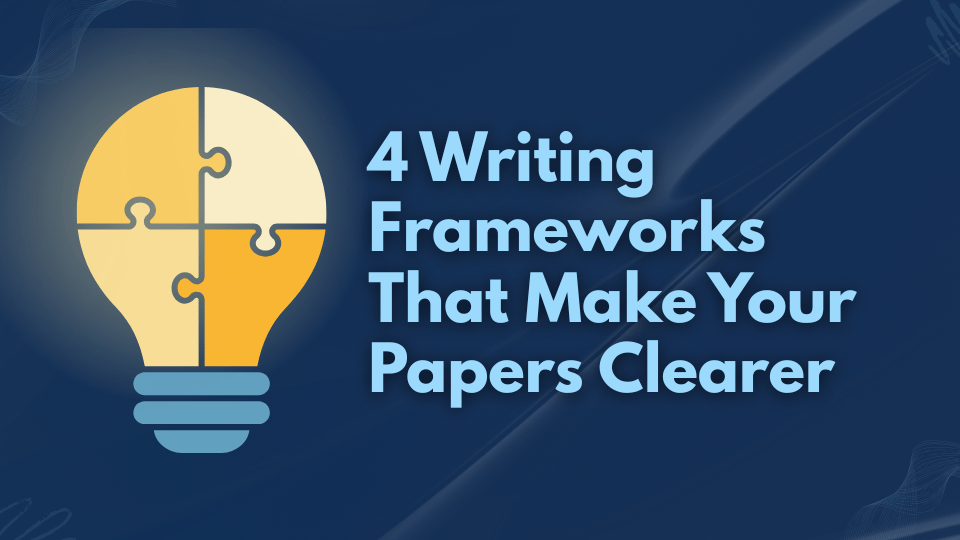
Once you see these four sentence-level patterns, you’ll start spotting them in every piece of academic writing you read. More importantly, you’ll be able to use them on purpose in the papers you write.
Most unclear writing isn’t unclear because of grammar mistakes. It’s unclear because of how the information is organized. These four frameworks – drawn from writing coach William Fitzpatrick’s analysis of how readers actually process text – give you a structural approach to organizing your sentences so your reader always knows what you’re talking about and where you’re going.
Once you understand the principle behind them, you’ll start noticing these patterns in the academic writing you already read, and you’ll be able to use them deliberately in the papers you write.
Every clause has two parts: the topic and the comment. The topic is the starting point – the familiar, already-established element the reader is standing on. The comment is what’s new – the information the reader is stepping into.
When those two roles are handled consistently, writing flows. When they’re scrambled – when new, unfamiliar ideas keep showing up at the front of the sentence – readers lose their footing.
The four frameworks below are four different ways to manage the relationship between topic and comment across a passage. Each one does something different, and each one is useful in different situations.
Use this framework when you want to develop multiple ideas about a single subject. The same element – or a pronoun or close synonym pointing back to it – stays in the topic position of every clause. All the new information builds up in the comment.
Here’s what it looks like in practice:
Bigfoot has been reported across nearly every U.S. state. It is consistently described as bipedal and covered in dark hair. Its footprints, when cast in plaster, suggest a stride length far exceeding that of any known primate. Despite decades of field investigations, it has never been captured or conclusively documented.
Notice that every sentence opens with the same subject – Bigfoot, it, its. The reader never has to reorient. New details accumulate in the comment position of each clause, but the anchor stays fixed.
This framework is well suited for description, character analysis, or any moment when you’re building a layered picture of one thing. The trade-off is if you use it for too long, the passage can feel static. Reserve it for passages where depth, not movement, is the goal.
Use this framework when you want to create a sense of forward movement. Instead of returning to the same topic, each new clause picks up an element from the end of the previous one and uses it as the new starting point. The writing steps forward, room by room:
Researchers have documented hundreds of Mothman sightings near Point Pleasant, West Virginia. Point Pleasant sits along the Ohio River, a corridor long associated with unusual aerial phenomena. These phenomena drew investigators from across the country in the late 1960s. The investigators produced conflicting accounts that remain unresolved today.
Each sentence hands off to the next: Point Pleasant → Ohio River → phenomena → investigators → accounts. The passage moves forward without jumping around.
This framework works well for process descriptions, causal chains, and methods sections – anywhere you’re taking the reader through a sequence of connected steps. The risk is that if you keep linking without a coherent thread, the passage drifts. Before you know it, you’ve traveled from coffee to typewriters to your creative writing professor. Keep the chain on track by making sure every link belongs on the same page.
This framework seems to break the rules of the first two: the topics don’t repeat, and they don’t link to each other. But it still works, because all the topics belong to a category that’s introduced up front.
Think of it like walking into a cathedral. Once you’re inside, you’re not surprised to find the nave, the pulpit, and the crypt. The whole establishes the context, and the parts follow naturally:
The Loch Ness Monster has been interpreted through three competing frameworks. Eyewitness accounts emphasize its serpentine neck and humped back. Sonar surveys have detected large, unidentified objects moving at depth. Biological analyses of water samples have found no environmental DNA consistent with a large, unknown vertebrate.
The opening sentence names the category, “three competing frameworks.” The sentences that follow are all different, but they all fit under the umbrella established at the start.
Without that opening “competing frameworks” clause, the passage falls apart. Readers need the umbrella to hold the parts together. If you find yourself writing a paragraph where the topics keep shifting, check whether you’ve given the reader the category first.
This framework is the most structured of the four. The opening clause announces two or three major elements: A, B, and C. Each of those elements then gets developed in turn. The reader receives a map before the tour:
Cryptozoologists distinguish three types of evidence: physical traces, eyewitness testimony, and photographic records. Physical traces include footprints, hair samples, and claw marks. Eyewitness testimony varies widely depending on observation conditions and the training of the witness. Photographic records, while numerous, have proved difficult to authenticate.
The first sentence sets up the three-part structure. Each sentence that follows develops one of the announced elements in the same order they were introduced.
One thing to watch: use the same terms (or close variants) when you pick up A, B, and C in the body of the passage. If you introduce “eyewitness testimony” in the preview and then refer to it as “personal accounts” or “witness statements” later, you’re asking the reader to do extra work to connect them. Exact repetition – or a close derivative like “eyewitness” and “witness” – keeps the structure tight.
This framework is especially useful for literature reviews, argument sections, and any passage where you’re synthesizing several distinct ideas into one coherent claim.
These frameworks don’t have to operate in isolation. A theme preview can introduce three sections, each of which uses a linking pattern internally. A categorical framework can contain paragraphs organized around a constant topic. The frameworks operate at different levels – sentence, paragraph, section – and they work together.
Once you can see them, you can start making deliberate choices in your writing. Which framework serves this particular passage? Where does the reader need an anchor, and where do they need momentum? Where do I need to name the category before I can describe its parts?
That’s the shift these frameworks make possible, taking you from writing that just happens to be clear to writing that’s organized to be clear from the start.
PERRLA handles the formatting side of your paper – citations, reference lists, margins, spacing – so you can focus on the writing itself. When you’re not spending mental energy on whether your in-text citations are correct or whether your Works Cited page is formatted correctly, you have more room to think about structure and clarity
PERRLA supports the latest versions of APA, MLA, and Turabian. Try it free for 7 days – no credit card required.
A writing framework is a structural pattern for organizing sentences within a passage. These frameworks aren’t style rules or personal preferences. Instead, they reflect the way readers actually process text. Using them deliberately helps you write more clearly, not just more correctly.
No. These four frameworks can be mixed and matched within the same paper, or even the same section. A theme preview might introduce a section that uses the linking pattern internally. The goal is to choose the framework that fits what a given passage needs to accomplish.
It depends on the passage. The constant topic works well for description and analysis. The linking pattern suits process writing and causal arguments. The categorical framework helps when you’re breaking a concept into its parts. The theme preview is useful for synthesizing multiple ideas. Many academic papers could benefit from all four at different points.
An outline organizes your ideas at the level of sections and paragraphs. These frameworks operate at the sentence level – they govern how individual clauses connect to each other within a passage. Both are useful, and they work at different scales.
Sometimes. If you’re stuck on a paragraph, identifying which framework fits what you’re trying to say can give you a starting point. If you’re building a causal argument, try the linking pattern. If you’re analyzing something from multiple angles, try the constant topic. Having a structural model can help reduce the uncertainty that makes a blank page feel daunting.
Fitzpatrick, W. [Writer Science]. (2026, August 20). The most powerful writing frameworks to write clearly [Video]. YouTube. https://youtu.be/cayUBPHB1HQ?si=63P9ecae2qi4xE7a
Learn the MLA 9 Works Cited format for books — one author, multiple authors, no author, editions, and translations — with in-text citation examples.
Five nursing programs ran full case studies with PERRLA, from a required rollout to one with no requirements at all. Here's what changed for faculty, students, and grades.
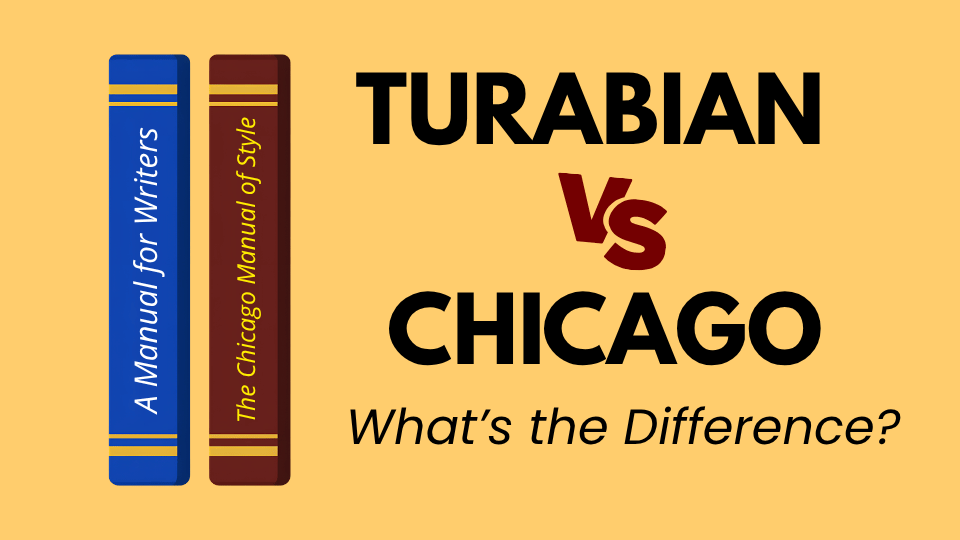
Turabian and Chicago are closely related, but they’re not the same thing. Here’s how the two guides differ, which citation system each one uses, and what PERRLA handles automatically when you start a Turabian paper.
PERRLA formats the whole paper in APA 7, MLA 9, and Turabian 9, from the title page to the last reference.
Try PERRLA free for 7 days