

The Turabian and Chicago formats are closely related, but they’re not quite the same thing. Kate Turabian’s A Manual for Writers of Research Papers, Theses, and Dissertations adapts Chicago style for students – covering the same two citation systems and many of the same rules, but with added guidance on research, argument, and paper organization that The Chicago Manual of Style doesn’t include.
The two guides share a foundation, but they aren’t interchangeable in every detail. Turabian’s 9th edition aligns with the 17th edition of The Chicago Manual of Style. Chicago’s 19th edition was published in 2024, and a 10th edition of Turabian is expected in late 2026, so if your instructor specifies a particular edition, use the one they name. When they just say “Turabian,” use the current edition of Turabian. When they just say “Chicago,” ask which edition they expect.
Same style, different audience
The Chicago Manual of Style is a comprehensive reference for writers, editors, and publishers. It covers citation conventions alongside typesetting, indexing, permissions, and publishing-specific topics. Most of that material has nothing to do with writing a history paper.
Turabian trims the publishing-specific material and adds sections on how to develop a research question, structure an argument, and present evidence. It adapts Chicago’s rules for students and academic researchers rather than simply reproducing them.
Turabian is essentially a more convenient, student-focused guide to Chicago style. But the two guides have different audiences and don’t always align for edition, so students should check their instructor’s directions rather than assuming the two titles are equivalent in every detail.
A tale of two citation systems
Both Chicago and Turabian use the same two citation systems. Your instructor will specify which one you should use, and if they don’t, your field of study usually makes it clear.
Notes and Bibliography
Footnotes or endnotes mark each citation in the text, with a superscript number after the relevant sentence. Full source details appear in the note itself. A bibliography is commonly included at the end of the paper, though whether one is required depends on the assignment and your instructor’s guidance. This system is common in history, theology, religious studies, and other humanities fields.
Author-Date
In-text citations appear in parentheses with the author’s last name, year, and page number – similar to APA format. A reference list (not a bibliography) at the end of the paper provides full source details in a different format from the Notes and Bibliography system. The Author-Date system is more common in the social and natural sciences.
If your instructor doesn’t specify which system to use, Notes and Bibliography is the more common default for humanities papers, and Author-Date for social science papers. As always, you should check your syllabus or ask first.
Basic Turabian formatting
These are the Turabian default formatting rules for a standard student paper – thesis and dissertation formatting, and some departmental assignments, may differ:
- Margins: 1 inch on all sides
- Font: A readable, consistent 12-point font – Times New Roman is a common choice, but follow your instructor’s requirements.
- Line spacing: Double-spaced body text
- Paragraph indent: 0.5 inches
- Title page: Paper title, your name, course name and number, instructor’s name, and submission date – centered on the page, following Turabian’s guidance and any instructor-specific guidance.
- Page numbers: Consecutive throughout, either upper-right or bottom center. The title page is counted but does not display a number. Institutional requirements can override these defaults.
PERRLA sets all of this automatically when you create a Turabian paper. You select Turabian as the format when you start, and the page layout, title page, and formatting are handled automatically from there.
How PERRLA handles Turabian
PERRLA builds your Turabian paper the same way it handles APA and MLA – the format is set when you create the paper, and citations are inserted as you write.
PERRLA supports the Notes and Bibliography system: it formats your footnotes and bibliography entries correctly so you don’t have to keep the rules in your head or divert your attention back and forth between your paper and the style manual.
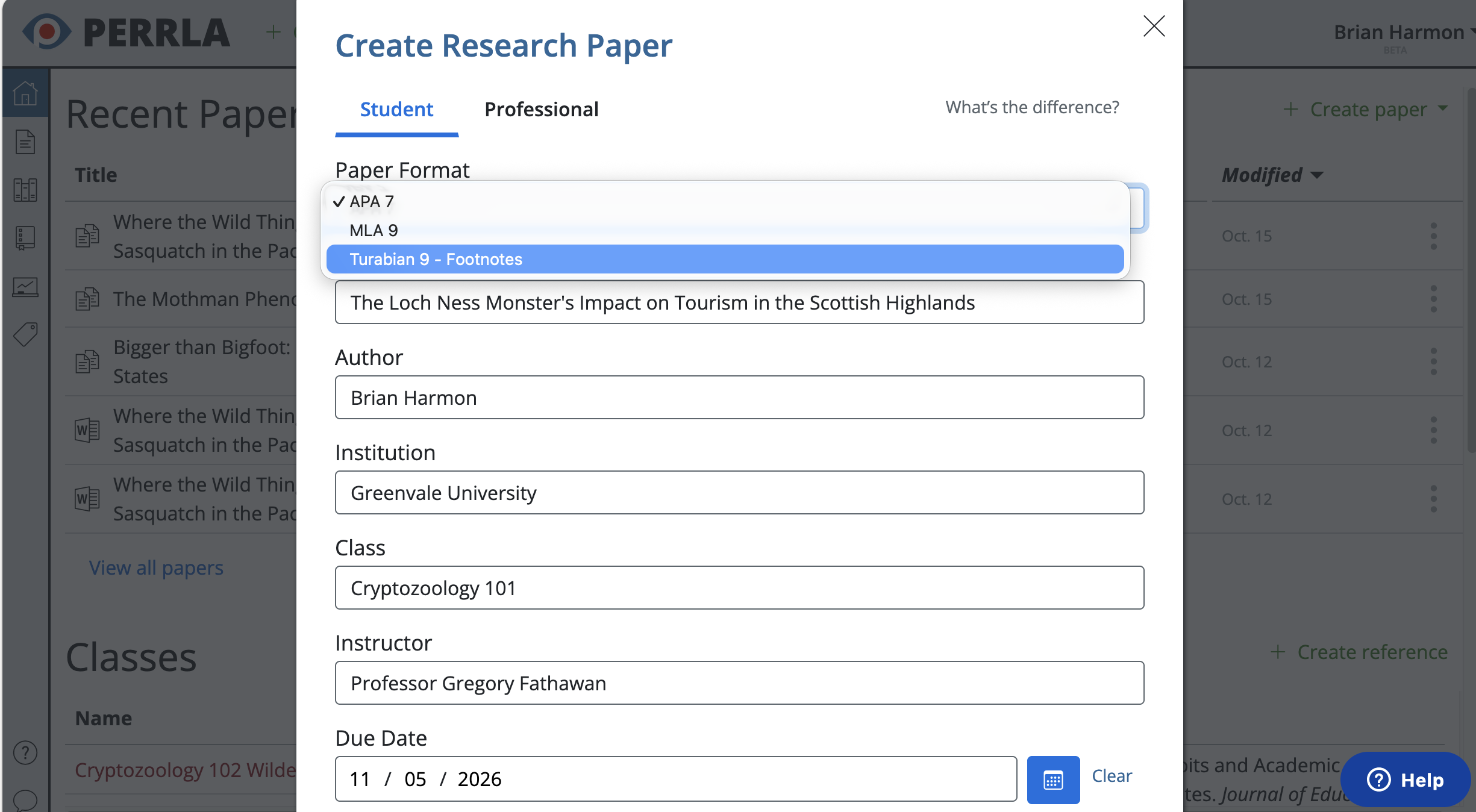
PERRLA’s 7-day free trial gives you full access to APA, MLA, and Turabian – no credit card required. Start a paper in the format your instructor requires, and PERRLA builds it from the first word.