

In the Turabian Notes and Bibliography system, footnotes and the bibliography work together. Footnotes point your reader to a source; the bibliography gives them the complete information to find it. In a typical Turabian Notes and Bibliography paper, both are required unless your instructor says otherwise.
This guide covers the bibliography as used in Turabian 9th edition’s Notes and Bibliography system – the citation style PERRLA supports. Turabian also offers an Author-Date system, which uses parenthetical citations and a reference list rather than footnotes and a bibliography. This guide does not cover that system.
The following sections cover how to format the bibliography page itself, how bibliography entries differ from footnote citations, and examples for the most common source types.
What is a Turabian bibliography?
A bibliography in Turabian lists the sources you cited in your paper and, when appropriate, other sources you consulted in your research. It appears at the end of the document, on its own page, and provides the full publication details for each source – the information a reader needs to locate the original.
Your instructor may also ask you to include additional sources you consulted during research. Such a list may be described as a bibliography, or works consulted list, depending on the assignment. Check your instructions if you’re not sure which is expected.
How to format the bibliography page
- Start on a new page at the end of your paper, after any endnotes if your paper uses them.
- Label: Center the word “Bibliography” at the top of the page. No bold, no italics, no quotation marks. Just plain centered text. Leave two blank lines between the heading and the first entry.
- Spacing: Single-space within each entry, with a blank line between entries.
- Hanging indent: The first line of each entry is flush with the left margin. Every subsequent line of the same entry is indented 0.5 inches.
- Alphabetical order: Entries are listed alphabetically by the author’s last name. If there is no author, alphabetize by the first significant word of the title.
How bibliography entries differ from footnote citations
This is where many students get tripped up. Bibliography entries look similar to footnote citations but follow different formatting conventions. The differences carry weight, and using one format in place of the other is one of the most common Turabian errors.
- Author name order: Footnotes list authors first name first (John A. MacGregor). Bibliographies invert the first author’s name, last name first (MacGregor, John A.), for alphabetization. Subsequent authors in the same entry are listed first name first.
- Publication details: In a typical book footnote, the place, publisher, and date appear in parentheses. In a bibliography entry, those elements are generally separated by periods rather than enclosed together in parentheses.
- Page numbers: Footnotes cite a specific page or pages. Bibliography entries for journal articles and book chapters include the full page range of the article or chapter, not a specific page.
- Punctuation: Bibliography entries generally use periods to separate major elements, while footnotes generally use commas.
- Ending: Every bibliography entry ends with a period.
Turabian bibliography examples
Book
MacGregor, Alastair. The Loch Ness Monster: A History of the Legend. Edinburgh: Highland Academic Press, 2019.
Book with two authors
Sergent, Donnie, and Jeff Wamsley. Mothman: The Facts Behind the Legend. Point Pleasant, WV: Mothman Press, 2002.
Book with three authors
Fraser, Duncan, Moira Sinclair, and Eilidh Ross. Cryptids of the British Isles. Glasgow: Caledonian Press, 2020.
Journal article
Campbell, Fiona. “Sonar Evidence and Aquatic Cryptids in Scottish Lochs.” Journal of Cryptozoological Studies 12, no. 3 (2021): 101–125.
Note: The bibliography entry includes the full page range of the article (101–125), not the specific page cited in a footnote. Article titles go in quotation marks; the journal name is italicized.
Journal article with a DOI
Ross, Eilidh. “Underwater Photography and the Nessie Question.” Scottish Journal of Natural History 8, no. 1 (2023): 44–58. https://doi.org/10.xxxx/xyz.
Chapter in an edited volume
Fraser, Duncan. “The 1933 Sightings: Setting the Record Straight.” In Cryptids of the British Isles, edited by Moira Sinclair, 67–89. Glasgow: Caledonian Press, 2020.
Note: The chapter title goes in quotation marks. The book title is italicized and preceded by “In.” The editor’s name follows in normal order (first name first), preceded by “edited by.” Include the page range of the full chapter.
Webpage
Wamsley, Jeff. “The Bridge Collapse and What Followed.” Loch Ness Research Foundation. April 10, 2023. https://www.example.com/bridge-collapse
Note: For webpages, include a publication, posting, or last-modified date when available. If no such date is available, include an access date instead.
Common Turabian bibliography mistakes
- Using footnote format in the bibliography – author names, punctuation, and page number conventions differ between the two. Never copy a footnote directly into the bibliography.
- Forgetting the hanging ident – one of the most visible formatting errors. Every line after the first in a bibliography entry must be indented 0.5 inches.
- Listing a specific page number instead of the full page range – bibliography entries for articles and chapters use the full range (101–125), not the page you cited in a footnote (115).
- Omitting the bibliography – in a typical Turabian Notes and Bibliography paper, both footnotes and a bibliography are required unless your instructor says otherwise. Footnotes alone are not sufficient.
- Using footnote punctuation in the bibliography – bibliography entries generally use periods to separate major elements, while footnotes generally use commas.
- Not alphabetizing entries – the bibliography must be in alphabetical order by the first author’s last name, or by the first major word of the title when there is no author.
Format your Turabian bibliography with PERRLA
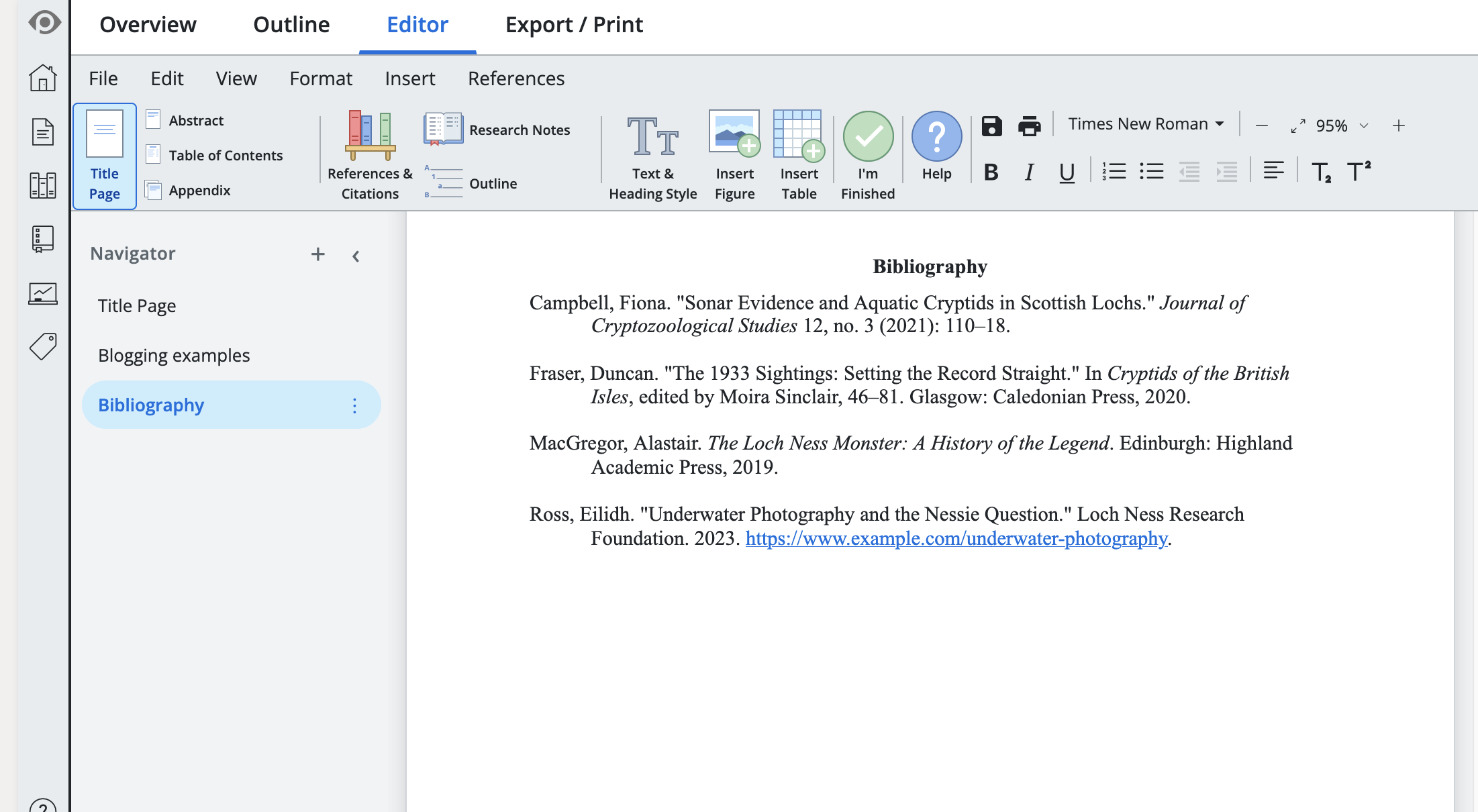
PERRLA supports the Turabian 9 Notes and Bibliography system and builds your bibliography automatically as you add references to your paper. Entries are formatted correctly – inverted author names, periods between elements, hanging indents, full page ranges for articles – and alphabetized automatically. Try PERRLA free for 7 days – no credit card required.
Frequently Asked Questions
Is a bibliography required in Turabian?
In a typical Turabian Notes and Bibliography paper, both footnotes and a bibliography are required unless your instructor says otherwise. Footnotes point readers to sources; the bibliography provides the full publication details. Check your assignment instructions if you’re unsure what your paper requires.
What is the difference between a Turabian bibliography and a works consulted page?
A bibliography normally includes the sources cited in your paper. Depending on the assignment, it may also include sources you consulted but did not cite. An instructor may instead ask for a selected bibliography or works consulted list that specifically includes additional research sources. Check your assignment instructions to confirm which is required.
How does a Turabian bibliography entry differ from a footnote citation?
Several ways: the first author’s name is inverted in the bibliography (last name first); in a typical book citation, publication details are separated by periods rather than enclosed together in parentheses; bibliography entries generally use periods to separate major elements; and journal article and chapter entries include the full page range rather than a specific page. Never copy a footnote directly into the bibliography.
How do you alphabetize a Turabian bibliography?
By the first author’s last name. If a source has no author, alphabetize by the first significant word of the title, ignoring “A,” “An,” and “The.”
Does a Turabian bibliography use a hanging indent?
Yes. The first line of each entry is flush with the left margin, and every subsequent line of the same entry is indented 0.5 inches. This is one of the most distinctive ane most commonly missed formatting requirements.
Does PERRLA format Turabian bibliographies automatically?
Yes. PERRLA supports the Turabian 9 Notes and Bibliography system and builds bibliography entries automatically as you add references, including correct author name order, punctuation, page ranges, and alphabetization.