

An abstract is a brief summary of your paper that appears before the body text. In APA 7, it has specific formatting requirements, a recommended word count, and a defined purpose.
This post covers everything: when an abstract is required, how to format it, what to include, what to leave out, and how keywords work.
Do you need an abstract?
For most student papers, the answer is: only if your instructor asks for one.
APA 7 makes abstracts optional for student research papers. They’re standard for professional research papers submitted for publication – journals expect them – but in a classroom context, your professor gets to decide. If the assignment instructions don’t mention an abstract, you probably don’t need one. If you’re not sure, ask.
The exception: some programs, particularly at the graduate level, require abstracts on all major papers as a matter of course. Capstone projects, theses, and dissertations almost always require them.
What an abstract is for
An abstract serves one primary purpose: it gives a reader enough information to decide whether the full paper is worth reading. In an academic database, the abstract is often all that’s visible before someone decides to download a paper. It needs to stand on its own.
A well-written abstract answers four questions in roughly equal measure:
- What was the problem or question?
- How was it addressed (method or approach)?
- What did the paper find or argue?
- What is the significance or implication?
Not every paper will have answers to all four in equal depth – a literature review looks different from an empirical study – but these are the questions a reader is asking when they read your abstract.
How to format an APA abstract
Page placement
The abstract appears on its own page, immediately after the title page and before the body of the paper. It is page 2.
The label
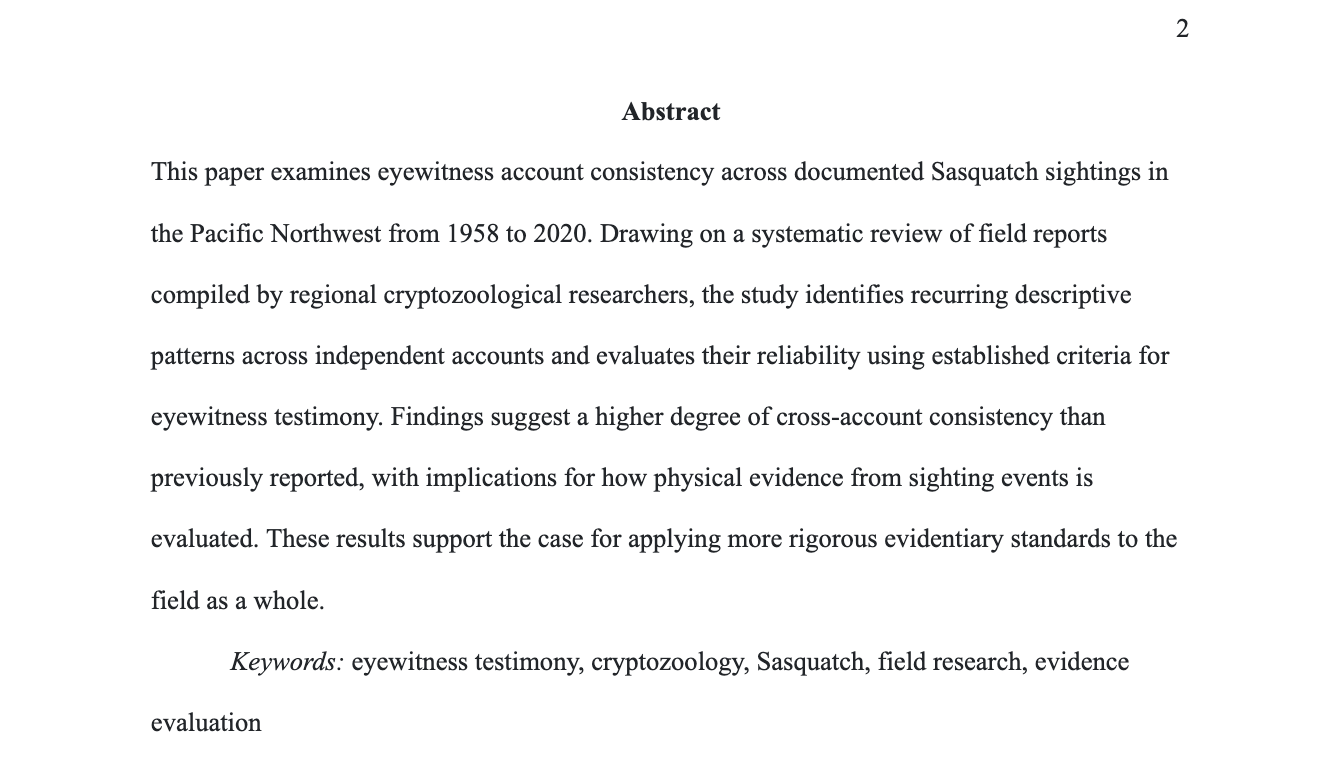
Center the word “Abstract” at the top of the page in bold. No italics, no quotation marks, no colon. Just the single word, centered and bold.
The text
The abstract text begins on the next line after the label – no indent on the first line. The text is double-spaced, the same as the rest of the paper.
Word count
APA 7 recommends 150 to 250 words for most abstracts. Some journals and programs specify a different limit. Always follow whatever limit your instructor or target journal sets.
What to include in an APA abstract
A strong abstract covers the essentials of your paper concisely, in plain language, without jargon where possible. Here’s what belongs:
- The topic or research question – what the paper is about, stated clearly and specifically
- Your approach – how you investigated or addressed the topic (a review of literature, an empirical study, a theoretical argument)
- Key findings or conclusions – what the paper determined or argued
- Implications or significance – why the findings matter, briefly
Write the abstract after you’ve finished the paper, not before. It’s a summary of what your paper actually says, and you can’t summarize something you haven’t written yet.
What to leave out
- Citations. Don’t cite sources in the abstract. If your paper builds on a specific study, you can refer to it briefly by author and year, but in general, keep citations out.
- New information. Everything in the abstract should appear in the paper itself. The abstract is a summary, not a supplement.
- Undefined abbreviations. If you use an abbreviation in the abstract, define it – the abstract stands alone and readers may encounter it independently of the paper.
- Evaluative language. Phrases like “This important study” or “This groundbreaking research” don’t belong in an academic abstract. State what the paper does without editorializing.
Keywords
Keywords appear below the abstract and help databases index and surface your paper in search results. In APA 7, keywords are optional for student papers but standard for professional papers. If your instructor requires an abstract, ask whether keywords are also expected.
Formatting keywords
The label “Keywords:” appears on the line immediately after the abstract text, indented 0.5 inches and italicized. The keywords themselves follow on the same line, in plain text – not italicized, not bolded. List them in lowercase (unless a term is a proper noun) and separate them with commas.
Example:
Keywords: academic writing, APA format, citation practices, research methodology
Choosing keywords
APA recommends three to five keywords. Choose terms that reflect the core concepts of your paper – the words a researcher would use to search for your topic in a database. Avoid terms that are too broad (psychology, education) or too narrow to be searchable.
What a formatted abstract looks like
Here’s an example of an abstract (created using PERRLA) to illustrate the formatting:
Adding an abstract in PERRLA
With PERRLA, you can add an abstract to your paper directly from the PERRLA toolbar. PERRLA creates the abstract page automatically with the correct label, placement, formatting, and keyword line, so you just need to write the content. Try PERRLA free for 7 days – no credit card required.
Frequently Asked Questions
Do student papers need an abstract in APA 7?
Not automatically. APA 7 makes abstracts optional for student papers. Whether you need one depends on your instructor’s requirements. Always check your assignment instructions or ask your professor.
How long should an APA abstract be?
APA 7 recommends 150 to 250 words. Some instructors or journals specify a different target. Follow whatever limit applies to your paper. If no limit is given, aim for somewhere in the middle of the APA range.
Is the abstract indented in APA 7?
No. The abstract is one of the few places in an APA paper where the first line is not indented. Start the abstract text flush with the left margin.
Where does the abstract go in an APA paper?
On its own page, immediately after the title page and before the body of the paper. It is page 2 of the document.
Can you include citations in an APA abstract?
Generally, no. Keep citations out of the abstract. The abstract should be a self-contained summary written in plain language.
Are keywords required in an APA abstract?
Keywords are optional for student papers and standard for professional papers. If your instructor requires an abstract, check whether they also expect keywords.
When should you write the abstract?
After you’ve finished your paper. An abstract summarizes what your paper says, and you can’t write it accurately until the paper is complete.