Quick Comparison
The Best Citation Generators for Students in 2026
Free vs. Paid, Honestly Compared
| Tool |
Free or Paid |
Styles |
Ads |
Formats Your Whole Paper?
|
Best For |
| PERRLA |
Paid (free trial) |
APA 7, MLA 9, Turabian 9 |
No |
Yes |
Students who regularly write formatted
academic papers
|
| Scribbr |
Free generator; paid services |
APA, MLA, others |
No |
No |
Quick citations plus editing add-ons
|
| ZoteroBib |
Free |
Thousands via CSL |
No |
No |
One-off bibliographies, any style
|
| EasyBib |
Free tier |
MLA free; others vary |
Yes |
No |
Fast single MLA citations
|
| Citation Machine |
Free tier |
APA, MLA, others |
Yes |
No |
Quick citations if you double-check
|
| ChatGPT |
Free and paid plans |
Any (unreliably) |
Yes (Free and Go plans) |
No |
Not recommended for generating citations
|
Comparison reflects the tools and features discussed
in this article. Features and pricing may change.
First, One Honest Disclosure
PERRLA is our software, and it appears on this list. So here's the deal we'll make with you: we'll describe every tool accurately, tell you when a free generator is genuinely the right call, and skip the fake star ratings. You're a student – you can smell a rigged review from a mile away.
What to Actually Look for in a Citation Generator
Accuracy against the current manual. APA 7 has been out since 2019 and plenty of free tools still slip on its rules. Whatever you use, spot-check the first few citations against your style guide. (There's a 60-second method for that below.)
Where the data comes from. Some tools pull source details from databases, some scrape them from pages, and some generate them from AI patterns. That last category can produce citations that look legitimate but don't check out.
Ads and upsells. Free generators are free because something else pays. Usually that's ads and aggressive upsell prompts, which is a fine trade for one citation and a tedious one for forty.
Whether references are the whole job. A generator hands you a formatted reference list. Your rubric may also grade the title page, page numbers, margins, headings, and in-text citations. If APA papers are a constant in your program, the reference list is only part of what you're being graded on.
PERRLA – Best for Frequent Academic Paper Writers
Full-paper formatting software rather than a standalone generator: it formats the title page, headings, margins, in-text citations, and references according to APA 7 guidelines and also supports MLA 9 and Turabian 9, with a reference engine built directly from the APA 7, MLA 9, and Turabian 9 manuals. It works in Microsoft Word, Word for Web, Google Docs, and PERRLA Online, and it never generates or alters your paper's content. It's paid with a free trial, and there's a dedicated support team available seven days a week until 10 p.m. Central.
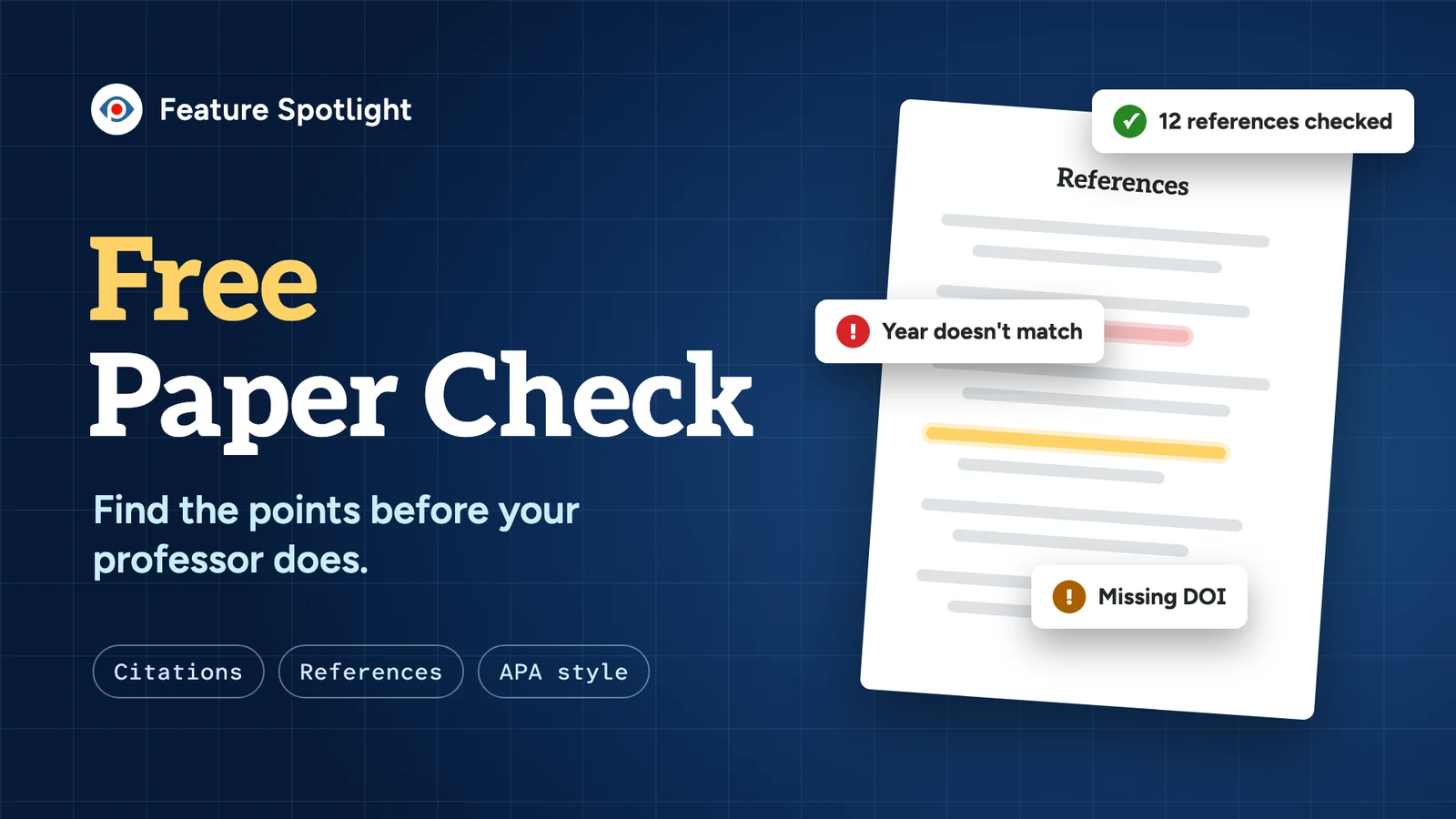
Two things matter most in a citation comparison. When you look up a source by its DOI, ISBN, or URL, the reference comes from the real record, and PERRLA never makes one up. And in PERRLA Online, before you download your paper, it reads the whole thing against the format rules and flags things like reference titles in the wrong capitalization, citations after the period, and references you never cited.
The honest fit: if you only write a few papers each year, a free generator below will probably do the job. If you're in nursing, education, psychology, or a graduate program where APA is constant, formatting the entire paper is the job – and that's what PERRLA is for.
Scribbr – Best for One-Off Citations
Scribbr offers a strong free citation generator alongside paid editing and plagiarism services. It's a good fit for one-off citations, but you're still formatting the rest of the paper yourself.
The generator itself is genuinely free. Scribbr's own FAQ promises "no costs, no ads, no limitations." You can search by title, URL, DOI, or ISBN, keep separate lists for each assignment, and export your list to Word or BibTeX. It also has a free extension for Chrome. Scribbr says the generator is built on the same open-source citation software as Zotero and Mendeley, with its own added layer for accuracy.
The paid side is sold one job at a time, not as a subscription:
- APA Citation Checker (AI): $9.95, APA only
- Citation Experts (people): $2.75 per source, any style
- Paper Formatting by Scribbr's editors: $1.95 per page
- Plagiarism Checker: $19.95 for a paper up to 7,499 words, $29.95 up to 49,999 words, $39.95 above that
ZoteroBib – Best Free Tool for Any Citation Style
ZoteroBib is the quick-bibliography cousin of Zotero: paste a URL, ISBN, or DOI and it builds your bibliography in the browser, no account or install needed. It supports more than 10,000 citation styles through the same CSL style library as Zotero, with no ads. For a one-off bibliography in an unusual style, it's hard to beat.
One thing to know before you rely on it: ZoteroBib saves your bibliography in your browser, not in an account. Close a private or incognito window and the list is gone. You can make a link to a copy, or export it as a BibTeX or RIS file. ZoteroBib's own help page says that if you need to reuse sources across projects, you should use Zotero itself instead (more on that below).
EasyBib – Best for Fast MLA Citations
One of the oldest names in the space and still fast for single citations. Free MLA citation generation remains its core offering, while broader style support and additional features sit behind upgrades. It's ad-supported, so it's a good idea to check the output against your style guide.
When we tried it in October 2026, the MLA generator worked without an account. Choosing APA sent us to a Chegg sign-up page first. EasyBib Plus is a monthly subscription that renews automatically, and Chegg's terms say the fees aren't refundable. Clicking Upgrade also took us to the sign-up page, so we couldn't see the price without making an account.
Citation Machine – Quick, With the Same Caveats
Similar to EasyBib, Citation Machine offers a free, ad-supported citation generator with support for multiple citation styles. It's a convenient option for creating individual citations, but it's still a good idea to review the output against your style guide.
It's run by Chegg, the same company as EasyBib. Citation Machine says it cites APA, MLA, Chicago, Turabian, and Harvard for free, with ads on the page. Citation Machine Plus starts with a free 3-day trial and adds no ads, 7,000 more styles, and the ability to create in-text citations and save them.
ChatGPT – The One We'd Steer You Away From
Students use it because it's fast and convenient. But AI chatbots are known to produce citations that look completely real – plausible authors, plausible journals – for sources that don't exist, and a fabricated reference is an academic integrity problem, not a formatting error. If you use ChatGPT to think, fine, within your school's policy. Don't rely on it to generate citations.
This isn't a hunch. In a 2023 study in Scientific Reports, researchers asked ChatGPT for short literature reviews and then checked all 636 references it produced. Of the GPT-3.5 references, 55% pointed to works that don't exist. The newer GPT-4 did much better at 18%, but even many real references had errors, and the authors' conclusion was that "problems remain" (Walters & Wilder, 2023). Chatbots have changed since 2023, so treat the exact numbers as history. The lesson still holds: check every reference a chatbot gives you, because your name is on the paper.
Fair is fair, so here's where PERRLA stands: it uses AI in one narrow spot. When you upload a PDF of an article, AI reads the first pages to help build the reference. It never writes anything in your paper.
A Note on Purdue OWL
Not a generator – it's the free reference guide that teaches the rules. Whatever tool you pick, Purdue OWL is a helpful reference when you want to check a formatting rule.
Also Worth Knowing
Not in the table above, but they come up a lot.
- MyBib. A free generator that says it has "no ads or privacy trackers." It says it runs on the same open-source formatting engine as Zotero and Mendeley and supports more than 10,000 styles. If you want a no-frills, ad-free generator, it's a strong pick.
- BibGuru. Made by the team behind the reference manager Paperpile. The free generator needs no sign-in, and there's an extension for Chrome and Edge. BibGuru Plus costs $4.99 a month after a 3-day free trial and adds saved sources, projects and folders, and an ad-free page.
- Zotero (the full app). Free, open source, and made by a nonprofit. Unlike ZoteroBib, it keeps a permanent library of your sources, with plugins for Word, LibreOffice, and Google Docs and more than 9,000 citation styles. The app is free; optional storage for syncing your files online runs $20 to $120 a year. It manages your sources and formats the bibliography, not the rest of the paper. We compare it with PERRLA in detail in PERRLA vs Zotero.
Where Generator Mistakes Come From
A generator is only as good as the information it's fed. Scribbr's own help center says no reference generator can guarantee 100% accuracy. Most mistakes trace back to a few places.
- Scraped page details. Many generators read the hidden details a web page publishes about itself. Those details are written for search engines, not for APA. A page title often carries the website's name ("... | Scientific Reports"), author names come through in full, and an article number can land in the "first page" field and print as a page.
- Title case where APA wants sentence case. Databases and publishers often store titles with every major word capitalized. APA 7 wants article and book titles in sentence case: capitalize the first word, the first word after a colon, and proper nouns. Journal names keep their capitals.
- Missing pieces. If the source's record has no issue number or page range, the generator can't invent one, so it leaves a gap you may not notice.
- Organizations as authors. When the author is an organization, like the Centers for Disease Control and Prevention, a generator can mistake it for a person and flip it into "last name, initials," or list the website's name as the author instead.
- Web pages with no date. APA 7 uses (n.d.) when a page has no date. Some generators fill in today's date or the copyright year from the page footer instead.
- The wrong source type. An article you read in a library database is a journal article, not a website. If you paste the database's URL, some generators cite it as a web page.
- Leftovers from older editions. APA 7 dropped "Retrieved from" before a link, the "DOI:" label, and the publisher's city. Older templates still add them.
How to Check Any Generated Citation in 60 Seconds
Here's a real journal article (fittingly, the ChatGPT study above), first as a generator can hand it to you and then fixed. We built the rough draft by hand to show the most common mistakes in one place; it isn't the output of any one tool, but every mistake in it is a common one.
The rough draft:
Walters, William H., & Wilder, Esther Isabelle. (2023, September 7). Fabrication and Errors in the Bibliographic Citations Generated by ChatGPT | Scientific Reports. Scientific Reports, 13(1), 14045. Retrieved September 12, 2026, from doi:10.1038/s41598-023-41032-5
The APA 7 version:
Walters, W. H., & Wilder, E. I. (2023). Fabrication and errors in the bibliographic citations generated by ChatGPT. Scientific Reports, 13(1), Article 14045. https://doi.org/10.1038/s41598-023-41032-5
Every detail in the fixed version matches the publisher's record. Here's the check, in order:
- Authors. Last name, then initials, with an ampersand before the last author. "William H." becomes "W. H."
- Date. A journal article gets the year only. The full date belongs to sources like news articles and blog posts.
- Title. Sentence case, with proper nouns kept: "ChatGPT" stays capitalized. Cut anything that isn't the title, like the website's name.
- Journal, volume, and issue. The journal name and the volume number are italic; the issue number in parentheses is not.
- Pages or article number. This journal numbers its articles instead of printing page ranges, so APA 7 writes "Article 14045," not a page.
- DOI. Written as a link that starts with https://doi.org/. No "DOI:" label, no "Retrieved from," and no retrieval date.
- Does it exist? Click the DOI. It should open the article you actually read. This one step is how you catch a made-up reference.
The Part Generators Don't Do: In-Text Citations
A generator builds the entry on your references page. Your paper also needs a citation in the sentence where you use the source, and that part is mostly on you. Some tools, like Scribbr and ZoteroBib, will give you the citation text to copy, but placing it, keeping it in sync, and handling the rules below is still your job.
- Parenthetical: (Walters & Wilder, 2023). The ampersand goes inside parentheses.
- Narrative: Walters and Wilder (2023) found... Use "and" when the names are part of your sentence.
- Three or more authors: use "et al." from the very first citation, like (Nguyen et al., 2024).
- Direct quotes: add the page number, like (Nguyen, 2024, p. 12).
- Placement: the citation goes before the period at the end of the sentence.
- Matching: every citation in your text needs an entry on your references page, and every entry needs at least one citation, with the same spelling and year.
That last rule is where hand-built papers break at the deadline: you cut a paragraph, and a reference is left with no citation. In PERRLA, you type ( in an APA paper and a citation picker opens at your cursor. Your references page builds itself from what you cite and stays in sync.
Free vs. Paid: The Actual Math
Free generators often cost time instead of money: ad-clicking, upsell-dodging, and double-checking output. That's a good trade at low volume. Paid full-paper formatting software costs money but can save you time spent checking formatting and citations. Neither answer is wrong – it depends entirely on how many APA papers stand between you and graduation.
Here's what that looks like with real October 2026 prices.
A couple of essays a semester. A free generator is the right call. ZoteroBib, MyBib, and Scribbr's generator cost nothing and show no ads. Budget about a minute per reference to check it, and format the rest of the paper by hand with your style guide open.
One big APA paper, one time. Say it's 12 pages. Scribbr's editors would format it for 12 × $1.95 = $23.40, and adding the APA Citation Checker brings it to $33.35, for that one paper, after it's written. A month of PERRLA is $12.95, and the 7-day free trial costs nothing and needs no credit card.
A degree full of APA. An RN-to-BSN student might write a discussion post every week and a paper most months. At one 8-page paper a month, per-page formatting is $15.60 a month before you count a single discussion post. PERRLA's 2-year plan is $129.95, about $5.41 a month, and covers every paper and post you write. A year is $79.95.
Two more numbers worth knowing. Every PERRLA purchase comes with a 30-day full refund, and active military and veterans get 50% off through support. And if you're at a community college or completing an associate degree, you may qualify for a free PERRLA plan through your school, so ask your school or our Support Team before you buy anything.
Frequently Asked Questions
What is the best free citation generator?
ZoteroBib for flexibility and thousands of citation styles; Scribbr for one-off citations; EasyBib for fast MLA citations. All handle references only, so budget time to verify against your style guide.
Can ChatGPT generate accurate citations?
Sometimes – and sometimes it invents sources that look real but don't exist, which is the problem. The only reliable way to know is to verify each reference against the original source.
What's the difference between a citation generator and citation software?
Generators format individual references or a bibliography. Software like PERRLA formats the entire document – title page through reference list – to the style manual your professor grades against. Our rundown of APA formatting software covers the full-paper tools.
Do citation generators work for APA 7?
Many do, but it's still worth verifying that the tool supports APA 7, since some citation tools and online guides still reflect older rules. When in doubt, check against Purdue OWL or the manual itself.
Which citation tool is best for nursing students?
APA is widely used throughout nursing education, making full-paper formatting software especially useful for students who regularly write APA papers. We cover this in more detail in our APA Formatting for Nursing Students guide.
Are free citation generators accurate?
Mostly, when the source's details are good. Use the 60-second check above on every reference, and look hardest at titles, organization authors, and web pages with no date.
Do I need a retrieval date in APA 7?
Usually not. Journal articles and books never get one, and APA 7 dropped "Retrieved from" before links. A retrieval date is only for a page that's designed to change over time and isn't archived, like the U.S. Census Bureau's population clock.
What does "n.d." mean in a reference?
"No date." APA 7 uses (n.d.) when a source doesn't show when it was published. Don't use the date you read it or the copyright year in the page footer.
Is EasyBib free for APA?
Its MLA generator is free and works without an account. When we tried APA in October 2026, it sent us to a Chegg sign-up page first. If you need free APA citations, Scribbr, ZoteroBib, and MyBib all offer them.
Does PERRLA have a free version?
PERRLA has a 7-day free trial with no credit card required, and every feature is included. After that it's a paid plan starting at $12.95 a month. Some schools give their students PERRLA through a site license, so check with yours first.
Can I move my citations from a generator into PERRLA?
Often, yes. ZoteroBib and Scribbr can both export a BibTeX (.bib) file, and PERRLA Online and the PERRLA add-in for Word can import one. Glance over each reference once it comes in, since a generator's mistakes come along with it.